Close
Approach Words: Environment Preservation, Sustainability, Urban Livability
Public Policy Instruments: Communicative, Physical Intervention
The Recycling Banks project is a strategic waste management initiative in Amman, Jordan, aiming to transform household and commercial waste practices.1 By establishing collection hubs for recyclable materials with market value, the project aims to divert valuable waste from landfills2 and promote sustainable recycling practices among residents and businesses.3
It provides accessible recycling banks and implements incentive mechanisms targeting significant reduction of allowing mixed waste to end up in landfills, fostering community environmental engagement.4
It envisions “to cultivate a culture of recycling in Amman, addressing environmental, social and economic challenges associated with solid waste,” and reducing the waste volume directed to the Ghabawi landfill.5
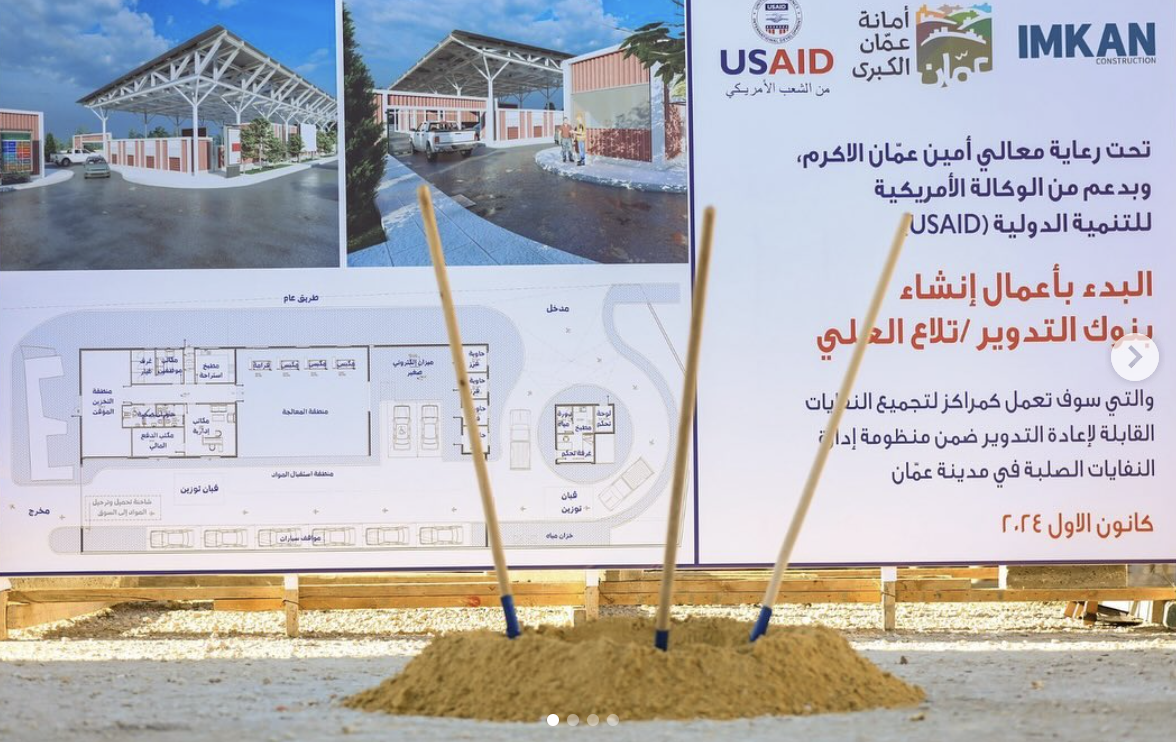
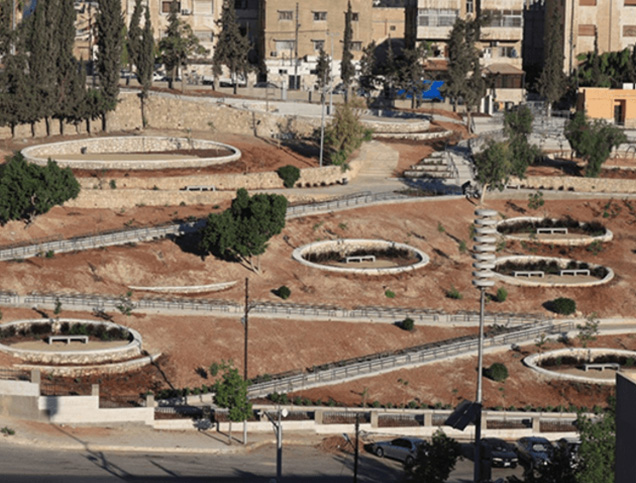
Title: Recycling Banks Center under Implementation in Tla Al Ali.
Source: Click Here
Title: Recycling Banks Center under Implementation in Tla Al Ali.
Source: Click Here
To realize its objectives, the project is integrated into the Greater Amman Municipality’s (GAM) strategic framework for solid waste management, adopted in 2022.6 It is part of the United States Agency for International Development (USAID) comprehensive program to promote recycling practices and bolster private-sector engagement for sustainable waste management in Jordan.7
To implement the vision, a recycling center spanning 3,000 square meters was introduced in Tla Al Ali neighborhood.8 Recycling banks will act as dedicated collection points for recyclables, aligning with international commercial waste recycling; processing separated materials such as plastics, paper, metals, and cardboard.9 Strategically placed in residential and commercial areas to facilitate the collection of source-separated recyclables.10
To achieve its goals, the project incorporates incentive programs, offering point-based rewards or direct purchase schemes for proper waste sorting.11 Besides educational campaigns, conducting workshops and awareness sessions were organized targeting sanitation workers, schools, residential communities, commercial establishments, and businesses12 to promote the benefits of recycling and address public concerns.13


Contractor/Implementer
Contractor/Implementer
This innovative model promotes environmental sustainability, community participation, and economic efficiency through a recyclable model that replaces traditional mixed waste collection with an efficient sorting system, preventing recyclable materials from being discarded to landfills.14
Funded by USAID,15 the project is initiated by the Greater Amman Municipality in collaboration with the Ministry of Environment.16 Implemented by Imkan Construction,17 the center is Expected to be operational by mid-2025.18
Project Link
Endnotes
N.A.
References
An online library where you can explore relevant data on urban development in the Arab cities.
More



Lorem ipsum dolor sit amet consectetur. Lacus nibh neque erat massa elementum. Ultricies ante sed sed nunc massa ider.
Last updated 3 mins ago
Lorem ipsum dolor sit amet consectetur. Lacus nibh neque erat massa elementum. Ultricies ante sed sed nunc massa ider.
Last updated 3 mins ago
Lorem ipsum dolor sit amet consectetur. Lacus nibh neque erat massa elementum. Ultricies ante sed sed nunc massa ider.
Last updated 3 mins ago
Lorem ipsum dolor sit amet consectetur. Lacus nibh neque erat massa elementum. Ultricies ante sed sed nunc massa ider.
Last updated 3 mins ago
Lorem ipsum dolor sit amet consectetur. Lacus nibh neque erat massa elementum. Ultricies ante sed sed nunc massa ider.
Last updated 3 mins ago
Lorem ipsum dolor sit amet consectetur. Lacus nibh neque erat massa elementum. Ultricies ante sed sed nunc massa ider.
Last updated 3 mins ago