Close
Approach Words: Efficiency, Environment Preservation, Sustainability
Public Policy Instruments: Communicative, Organization, Physical Intervention, Planning
The Clean 8 initiative is a municipal waste-collection digitalization program piloted in Tunisia’s cities of Djerba-Midoun, Gabès, and Kairouan under GIZ’s regional “City-to-City Cooperation Maghreb-Germany (KWT II)” program.i 1 Running from March 2020 to February 2024, the project equips municipalities, waste-collection drivers, and residents with a shared platform for route optimization, issue reporting, fleet monitoring. By using real-time data, it improves service responsiveness while cutting fuel consumption and operational costs.2
Clean 8 envisions a “transparent, citizen-engaged, and resource-efficient municipal waste system where digital tools reduce environmental impact and raise service quality”.3 The project aims to enhance the speed, transparency, and inclusiveness of waste services through digital tracking, community feedback, and capacity-building for municipal teams, establishing a scalable model for other Tunisian municipalities.4
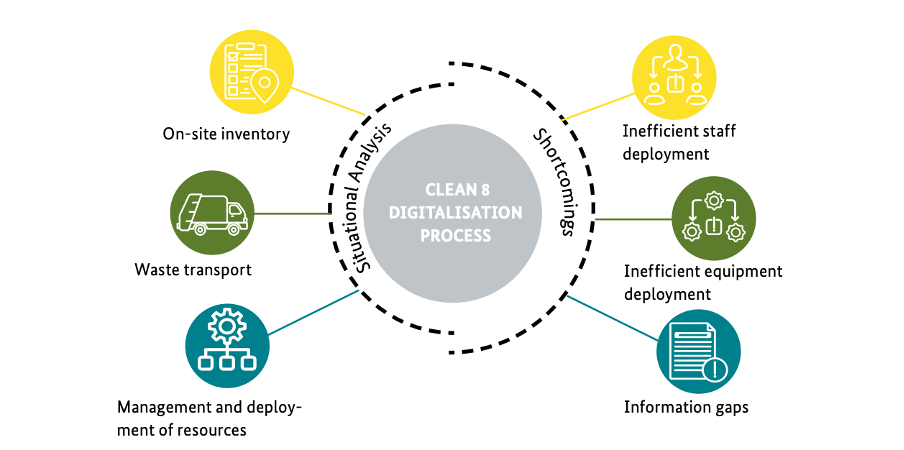
Title: The Methodological Approach of the Project.
Source: Click Here
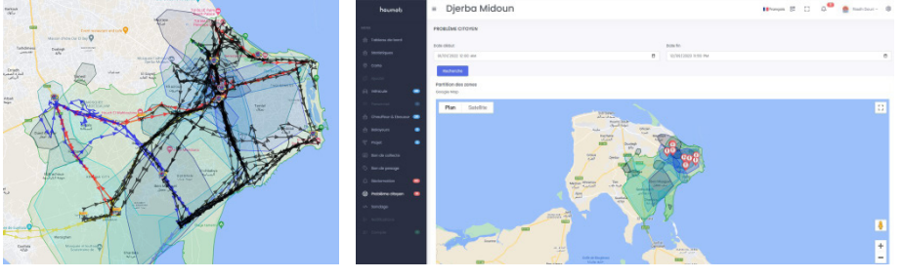
Title: Maps Showing Real-Time Tracking of Waste Collection Routes and precise geolocation of all requests.
Source: Click Here
Title: The Methodological Approach of the Project.
Source: Click Here
Title: Maps Showing Real-Time Tracking of Waste Collection Routes and precise geolocation of all requests.
Source: Click Here
To implement this vision, Clean 8 integrates several interlinked digital and managerial components:5 6
According to the October 2024 factsheet, early deployment achieved 15 percent average fuel-cost savings and introduced GPS-based tracking, dashboards, and geolocated citizen complaints, demonstrating measurable operational and environmental benefits.7

Owner/Developer (Public)

Contractor/Implementer
Owner/Developer (Public)
Contractor/Implementer
Clean 8 is by GIZ under the City-to-City Cooperation Maghreb-Germany (KWT II) program, together with the Service Agency SKEW/Engagement Global, commissioned by BMZ.8 Tunisia’s Ministry of Interior, through its Directorate-General of External Relations & Decentralized International Cooperation, ensures policy alignment and national integration.9 The municipalities of Djerba-Midoun, Gabès, and Kairouan operate the system daily;10 while an ecosystem of local partners, including tech start-ups such as the “Houmati/Clean 8” toolchain and development actors such as UN-Habitat, support system integration, scale-up, and linkage to related waste-management and climate-action programs.11
Project Link
https://www.giz.de/de/downloads/giz2024-en-sheet-clean-8-tunisia.pdf
Endnotes
References
An online library where you can explore relevant data on urban development in the Arab cities.
More


Lorem ipsum dolor sit amet consectetur. Lacus nibh neque erat massa elementum. Ultricies ante sed sed nunc massa ider.
Last updated 3 mins ago
Lorem ipsum dolor sit amet consectetur. Lacus nibh neque erat massa elementum. Ultricies ante sed sed nunc massa ider.
Last updated 3 mins ago
Lorem ipsum dolor sit amet consectetur. Lacus nibh neque erat massa elementum. Ultricies ante sed sed nunc massa ider.
Last updated 3 mins ago
Lorem ipsum dolor sit amet consectetur. Lacus nibh neque erat massa elementum. Ultricies ante sed sed nunc massa ider.
Last updated 3 mins ago
Lorem ipsum dolor sit amet consectetur. Lacus nibh neque erat massa elementum. Ultricies ante sed sed nunc massa ider.
Last updated 3 mins ago
Lorem ipsum dolor sit amet consectetur. Lacus nibh neque erat massa elementum. Ultricies ante sed sed nunc massa ider.
Last updated 3 mins ago