Close
Approach Words: Capacity Building, Environment Preservation, Urban Resilience
Public Policy Instruments: Communicative, Financial Mechanism, Organization, Physical Intervention, Planning, Regulatory
The Household Solid Waste Generation and Composition in Homs, Jableh, and Banyas City project is a detailed evaluation initiative focusing on the quantity and nature of household solid waste in these Syrian cities.1 It is unique because it employs direct waste analysis, including sampling, sorting, and weighing waste from 300 families across distinct city zones in Homs, which insures reliable and highly localized data.2 3 The study was conducted between July 2017 and February 2019 to fill critical knowledge gaps needed for better municipal solid waste management planning.4
The project’s vision is to generate accurate and actionable data to support environmental planners and city authorities in addressing the growing waste challenges in Syrian cities.5 6
The project aims to assess household waste generation rates, analyze the waste’s composition, and understand socioeconomic factors influencing waste patterns, aligning with broader efforts to improve and make municipal solid waste management in Syria more sustainable.7 8
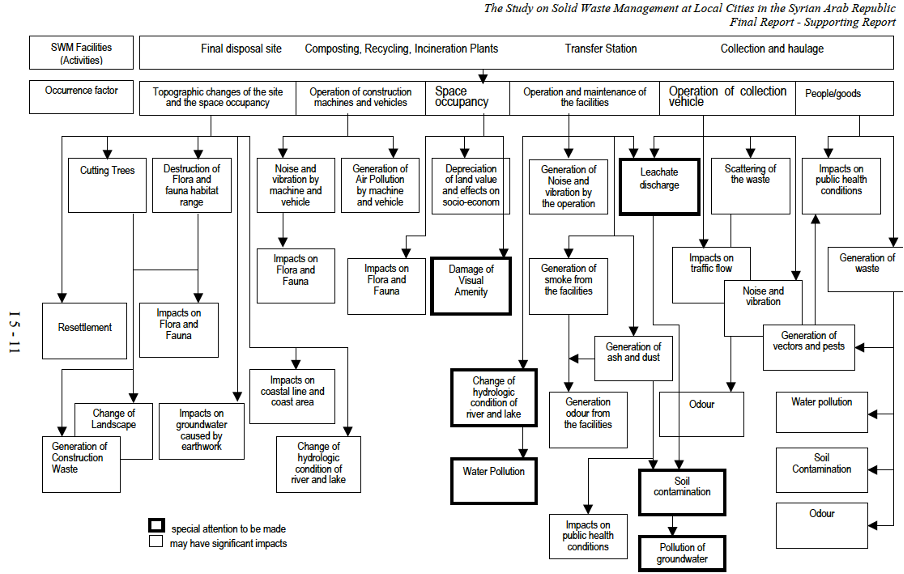
Title: Impact Prediction Flow of SWM
Source: Click Here
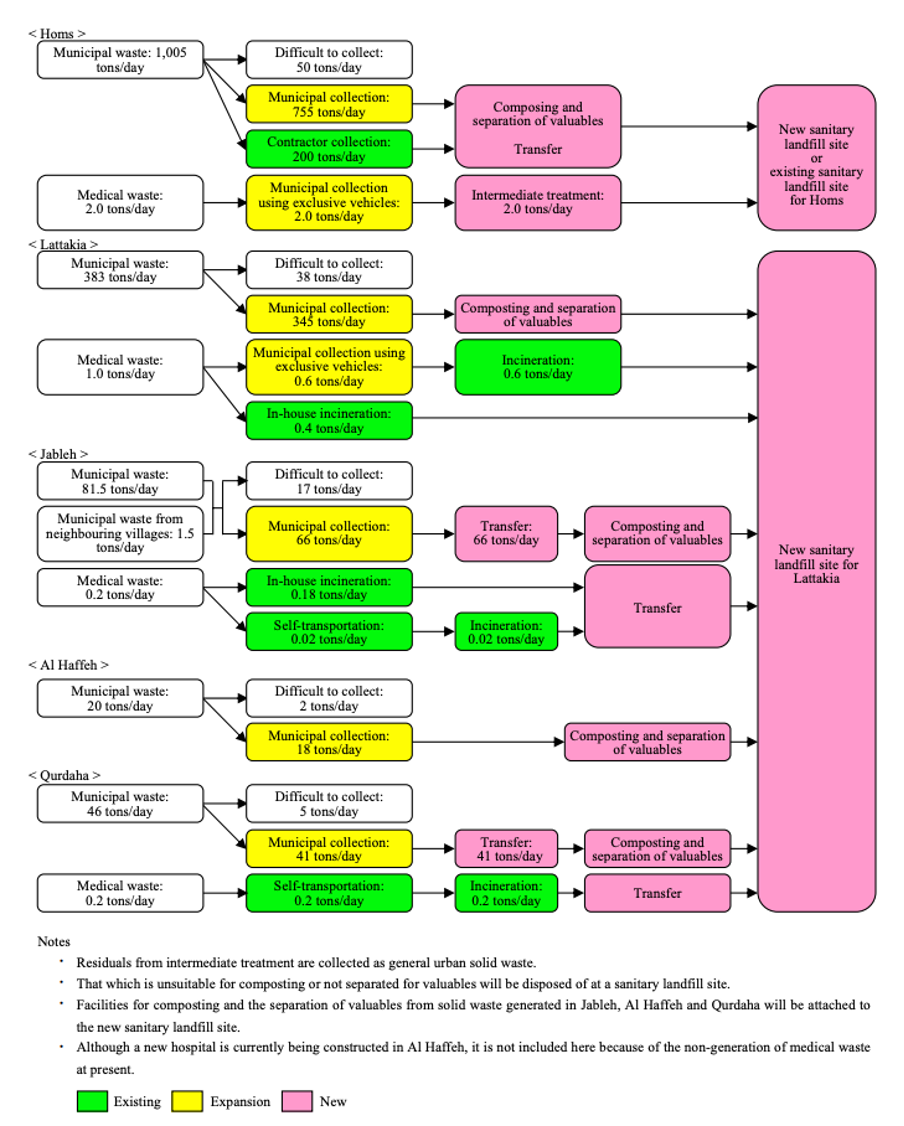
Title: Design Flow of Solid Waste Disposal.
Source: Click Here
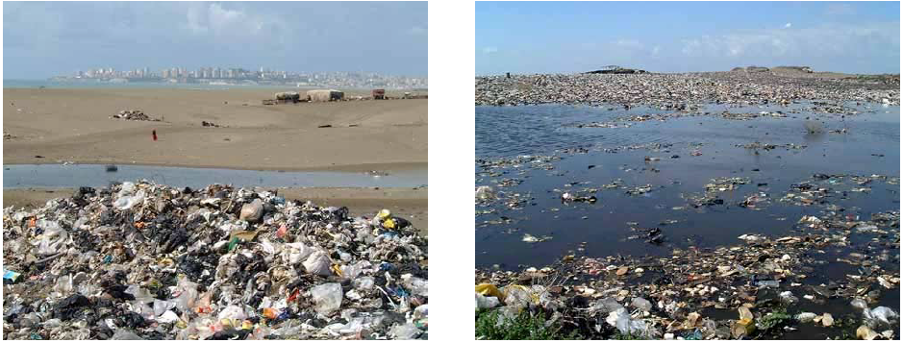
Title: Lattakia urban area scene from Al Bassa Dumping site and Leachate water from indiscriminate wastes.
Source: Click Here
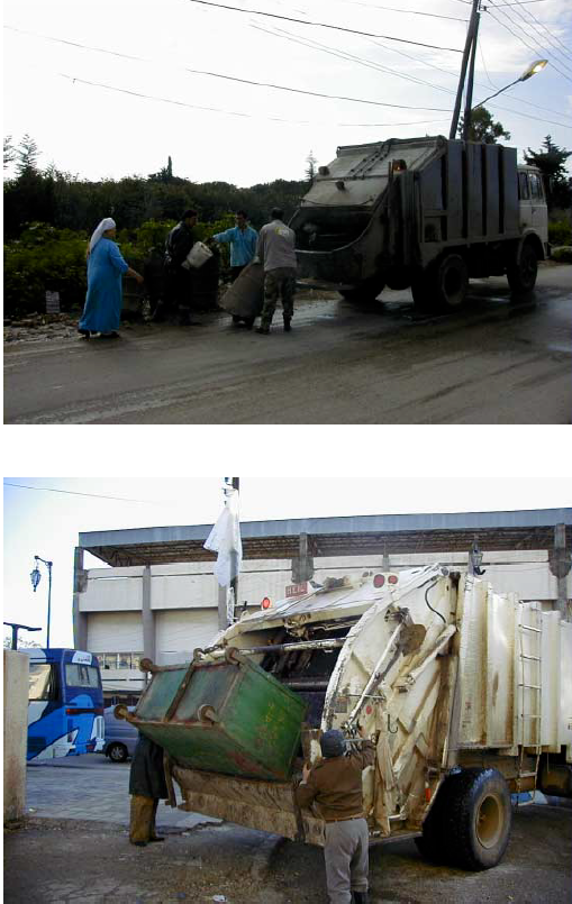
Title: solid waste collection methods in the cities.
Source: Click Here
Title: Impact Prediction Flow of SWM
Source: Click Here
Title: Design Flow of Solid Waste Disposal.
Source: Click Here
Title: Lattakia urban area scene from Al Bassa Dumping site and Leachate water from indiscriminate wastes.
Source: Click Here
Title: solid waste collection methods in the cities.
Source: Click Here
To implement its objectives, the project focuses primarily on the household waste stream, which represents about 80% of municipal solid waste in Syrian cities.9 Key components include:10
• Quantification of per capita solid waste generation
• Detailed waste composition analysis, showing that organic waste makes up 69.1%, followed by plastics (10.6%), inert materials (8.7%), and smaller shares of paper, textile, metal, glass, and hazardous waste
• Socioeconomic surveys to identify factors influencing waste production
The findings highlight opportunities for composting and recycling to reduce landfill loads and mitigate pollution risks.11 12 They also note that existing disposal sites, such as those in Jableh, require rehabilitation, and that improving site operations and reaching consensus on new disposal facilities are essential for sustainable waste management infrastructure.13
The project is managed through collaboration between local authorities in the three cities with international partners, including the Japan International Cooperation Agency (JICA), which provided technical support and surveys (Jableh and Banyas).14 15 Besides, municipalities and stakeholders, working together to address infrastructure challenges and improve disposal site operations.16


Consultant/Designer

Consultant/Designer
The project is ongoing and key completed phases include field sampling from 300 families and detailed data analysisof waste generation and composition. These outputs provide a refined knowledge base for future strategic planning in solid waste management across the three cities.18 19
Upon completion, the Household Solid Waste Generation and Composition project will provide foundational data that will enable more effective solid waste management policies, environmentally sustainability practices, and public health improvements across Homs, Jableh, and Banyas.20
Project Link
Endnotes
N.A.
References
An online library where you can explore relevant data on urban development in the Arab cities.
More




Lorem ipsum dolor sit amet consectetur. Lacus nibh neque erat massa elementum. Ultricies ante sed sed nunc massa ider.
Last updated 3 mins ago
Lorem ipsum dolor sit amet consectetur. Lacus nibh neque erat massa elementum. Ultricies ante sed sed nunc massa ider.
Last updated 3 mins ago
Lorem ipsum dolor sit amet consectetur. Lacus nibh neque erat massa elementum. Ultricies ante sed sed nunc massa ider.
Last updated 3 mins ago
Lorem ipsum dolor sit amet consectetur. Lacus nibh neque erat massa elementum. Ultricies ante sed sed nunc massa ider.
Last updated 3 mins ago
Lorem ipsum dolor sit amet consectetur. Lacus nibh neque erat massa elementum. Ultricies ante sed sed nunc massa ider.
Last updated 3 mins ago
Lorem ipsum dolor sit amet consectetur. Lacus nibh neque erat massa elementum. Ultricies ante sed sed nunc massa ider.
Last updated 3 mins ago