Close
Approach Words: Urban Resilience
Public Policy Instruments: Financial Mechanism, Physical Intervention, Planning, Regulatory
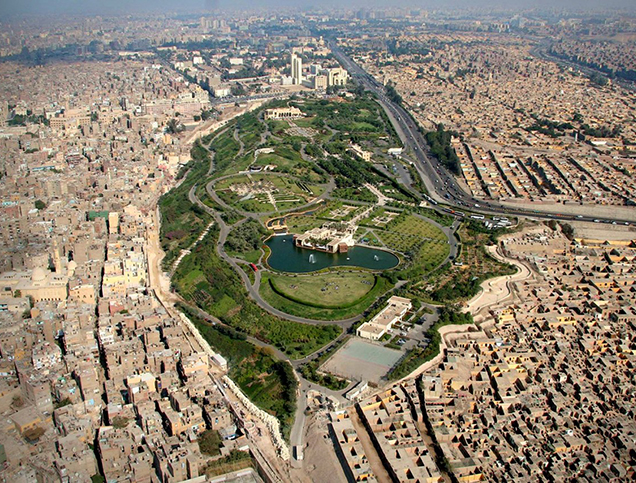
The Manshiyat Naser Recycling Community (Zabaleen), located between the Muqattam Hills and the long-established informal settlement of Manshiet Nasser in Cairo, is a rehabilitation initiative for one of the city’s largest informal settlements.1 This project is known for being home to the Zabaleen community, which is widely regarded as one of the most efficient resource recovery and waste recycling systems in the world.2 Their grassroots waste-management system has provided Cairo with recycling rates as high as 80 percent of collected municipal solid waste.3
The project’s vision is “to enhance the living conditions in Manshiet Nasser by rehabilitating the physical environment and reducing health risks to poor inhabitants.4 It aims to provide new housing to replace deteriorated structures, extend public spaces,5 install reliable water and sewerage system, and improve overall urban infrastructure.6
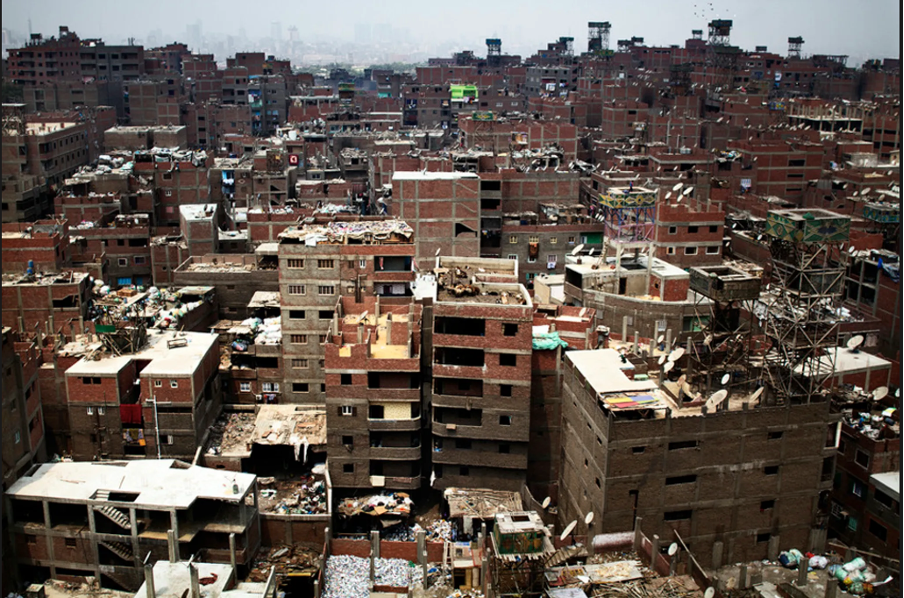
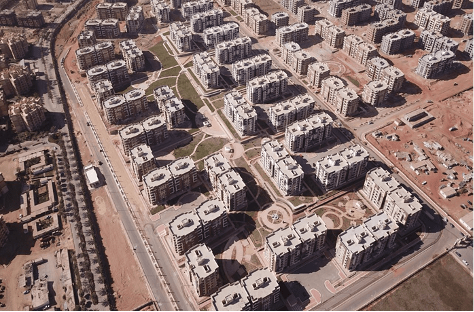
Title: Aerial view of the Manshiyat Naser community (Zabaleen), illustrating the high-density urban fabric and limited essential services.
Source: Click Here
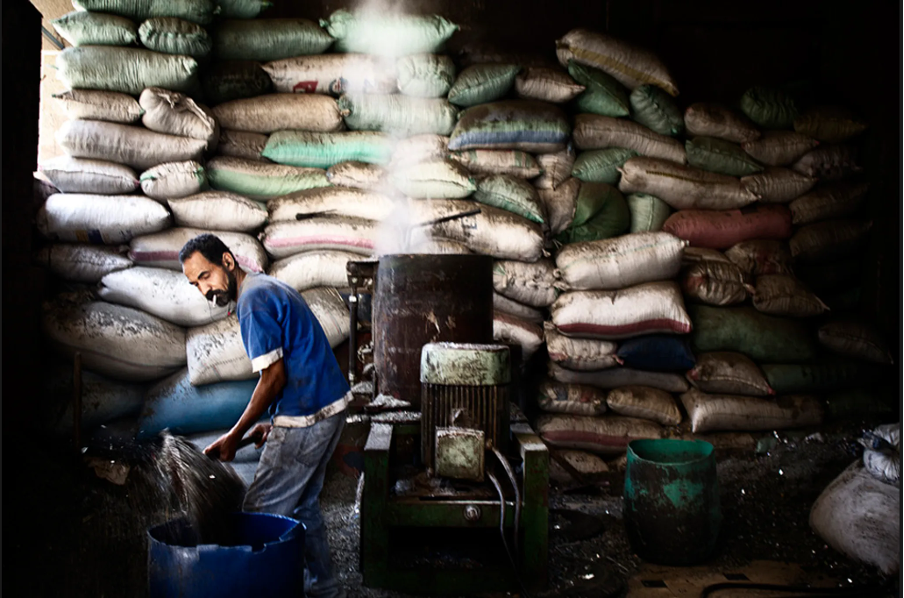
Title: Workers engaged in simple recycling process within one of the small-scale, informal recycling workshops in Manshiyat Naser.
Source: Click Here
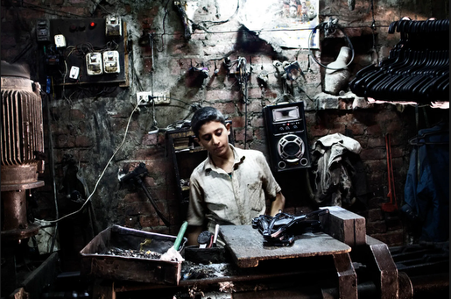
Title: Recycled plastic materials processed locally and sold in shops, providing a low-cost alternative for consumer products.
Source: Click Here
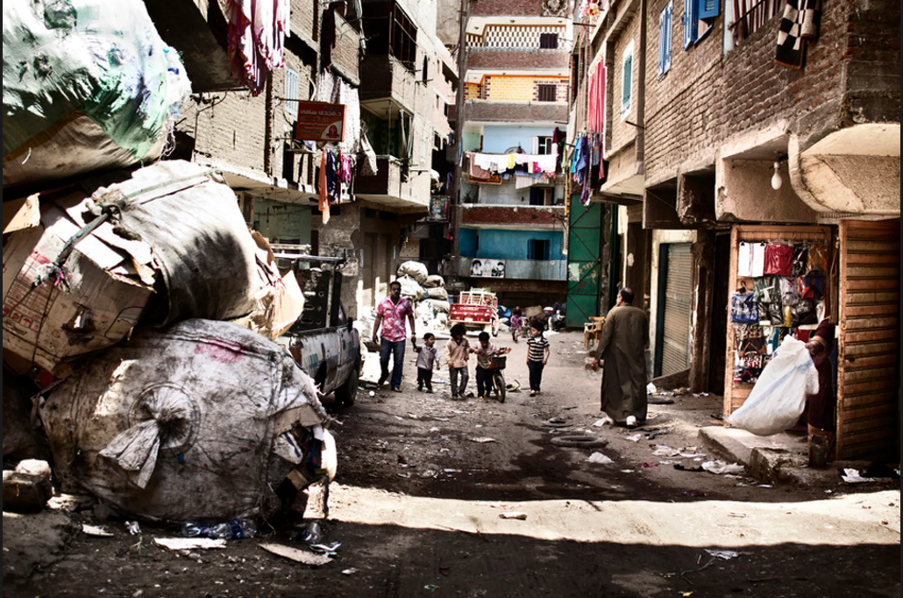
Title: Waste collected by informal pickers (Nabashiin) in Manshiyat Naser, aggregated and ready for sorting and processing.
Source: Click Here
Title: Aerial view of the Manshiyat Naser community (Zabaleen), illustrating the high-density urban fabric and limited essential services.
Source: Click Here
Title: Workers engaged in simple recycling process within one of the small-scale, informal recycling workshops in Manshiyat Naser.
Source: Click Here
Title: Recycled plastic materials processed locally and sold in shops, providing a low-cost alternative for consumer products.
Source: Click Here
Title: Waste collected by informal pickers (Nabashiin) in Manshiyat Naser, aggregated and ready for sorting and processing.
Source: Click Here
The settlement has evolved from an initial population of 5,514 in 1977 to over 800,000 by 2000, with the population more than tripling since 1981 although there has been very little expansion of the physical boundaries of the settlement.7
To implement these objectives, the project functions through a systematic master plan for the area’s rehabilitation. This plan covers an area of 13 feddan, with a population density of 385 persons per feddan and a current population of roughly 5,000.8 Implementation tools include:
The plan integrates sustainability by integrating the Zabaleen’s recycling practices into urban upgrading, reducing waste disposal burdens while generating livelihoods.14 15 The project also incorporates traditional practices such as donkey-carts collection, integrational participation, and family-based organization, that are integrated with modern infrastructure upgrades.16 Additionally, sustainability is supported by linking waste collection to recycling markets, where secondary materials such as paper, tin, rags, glass and plastics are sold to middlemen.
The project is managed and implemented by multiple stakeholders. The wahiya (traditional contractors) administer the system and market services, while the Zabaleen carry out waste collection and sorting. In 1989, the Environmental Protection Company (EPC) was established through an agreement between the wahiya and Zabaleen to formalize activities.17 Community-based organizations, NGOs like Community and Institutional Development (CID), local authorities, and international organizations also contributed in upgrading efforts. However, the project faces challenges from multinational municipal solid waste (MSW) companies, contracted at values up to USD 50 million annually, which compete with and threaten the Zabaleen’s role.18


Owner/Developer

Funder
Owner/Developer
Funder
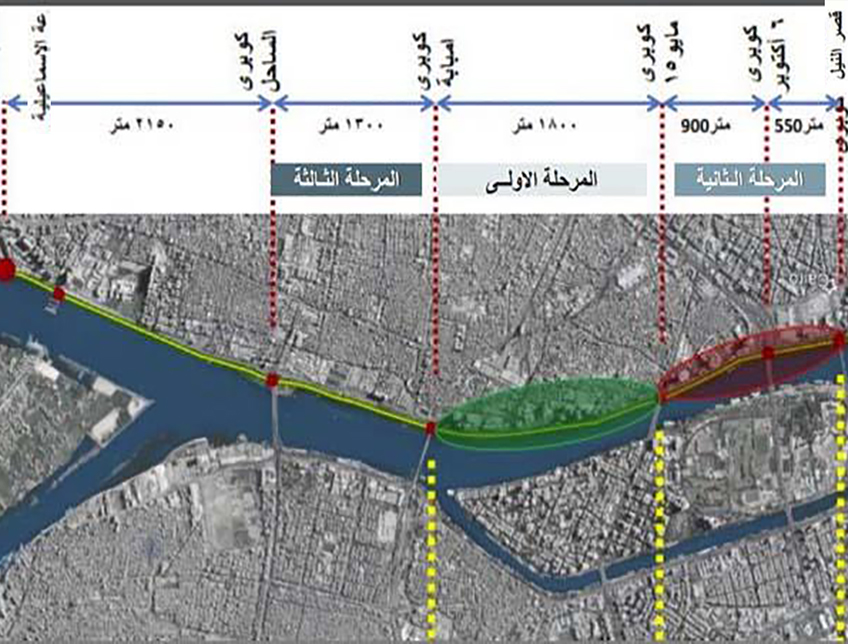
The project was initiated around the late 1950s and mid 1960s when the territory among the foothills of the Mokattam Mountains was developed by rural migrants from Upper Egypt.19 Its implementation follows systematic phases:20
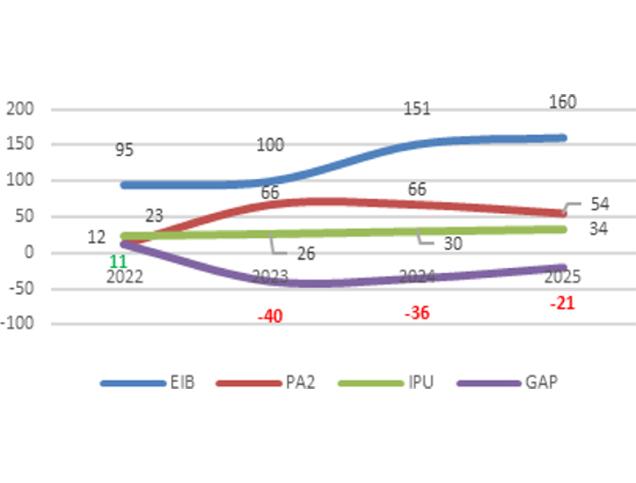
Currently, the project is ongoing. The population of Manshiyat Naser is projected to reach 8,000 by 2025, but challenges linked to privatization and exclusionary waste contracts threaten the socio-economic sustainability of the community.21 22
Upon completion, the Manshiyat Naser Recycling Community is expected to achieve maximum results with minimum impact by creating a cycle of actions that address urgent problems quickly, improve living conditions, and raise awareness of community rights. Most importantly, it demonstrates the potential of self-organization and grassroots expertise in shaping sustainable urban features.23
Project Link
https://www.erpublication.org/published_paper/IJETR042029.pdf
Endnotes
N.A.
References
An online library where you can explore relevant data on urban development in the Arab cities.
More


Lorem ipsum dolor sit amet consectetur. Lacus nibh neque erat massa elementum. Ultricies ante sed sed nunc massa ider.
Last updated 3 mins ago
Lorem ipsum dolor sit amet consectetur. Lacus nibh neque erat massa elementum. Ultricies ante sed sed nunc massa ider.
Last updated 3 mins ago
Lorem ipsum dolor sit amet consectetur. Lacus nibh neque erat massa elementum. Ultricies ante sed sed nunc massa ider.
Last updated 3 mins ago
Lorem ipsum dolor sit amet consectetur. Lacus nibh neque erat massa elementum. Ultricies ante sed sed nunc massa ider.
Last updated 3 mins ago
Lorem ipsum dolor sit amet consectetur. Lacus nibh neque erat massa elementum. Ultricies ante sed sed nunc massa ider.
Last updated 3 mins ago
Lorem ipsum dolor sit amet consectetur. Lacus nibh neque erat massa elementum. Ultricies ante sed sed nunc massa ider.
Last updated 3 mins ago