Close
Approach Words: Environment Preservation, Sustainability, Urban Livability
Public Policy Instruments: Communicative, Infrastructure, Planning
The Dubai Sponge City Initiative is a city-wide urban resilience and water-management program that introduces the “sponge city” approach into Dubai’s planning framework, focusing on managing rainfall through absorption, storage, filtration, and reuse rather than rapid runoff via conventional drainage systems.1 2
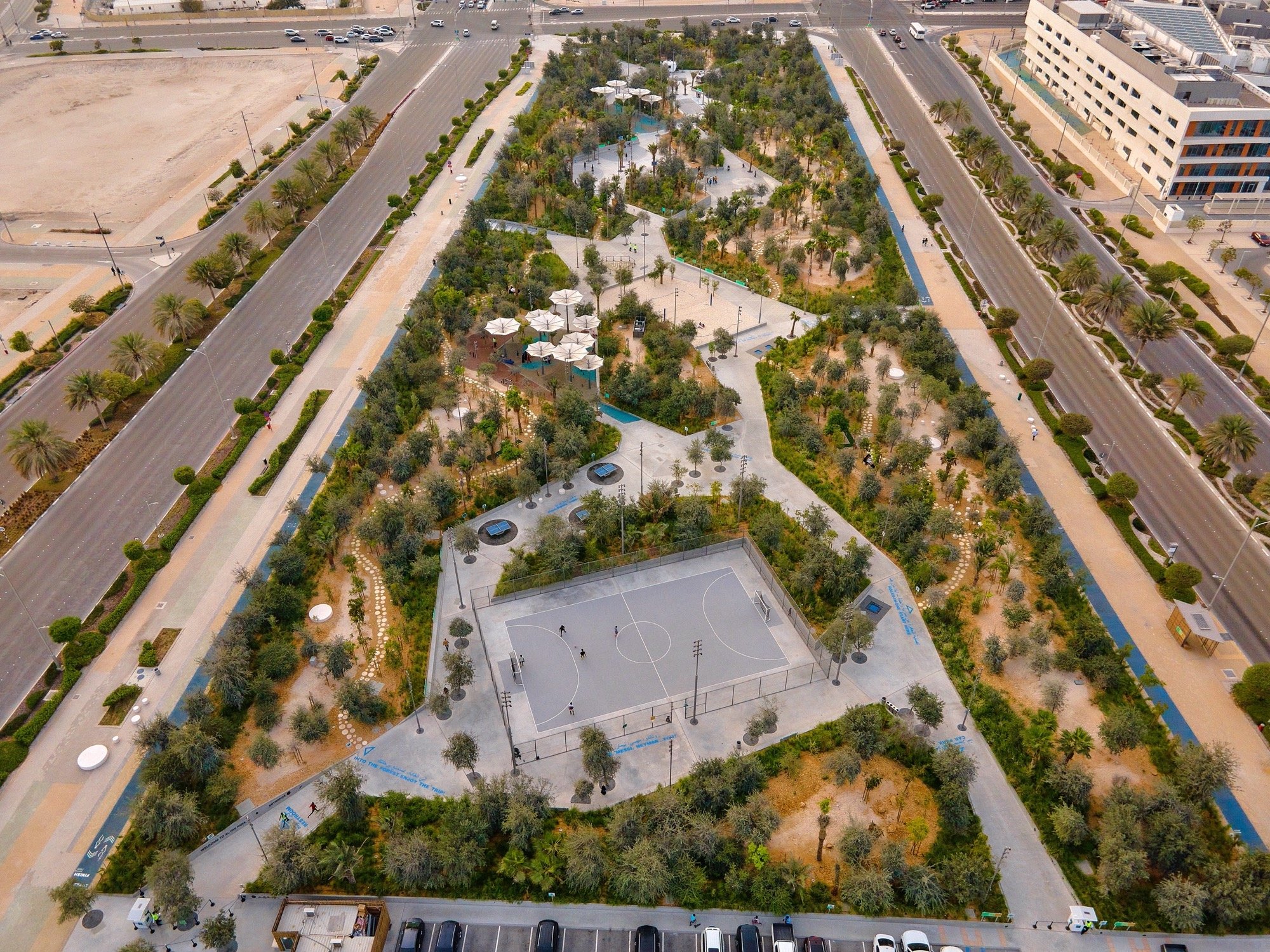
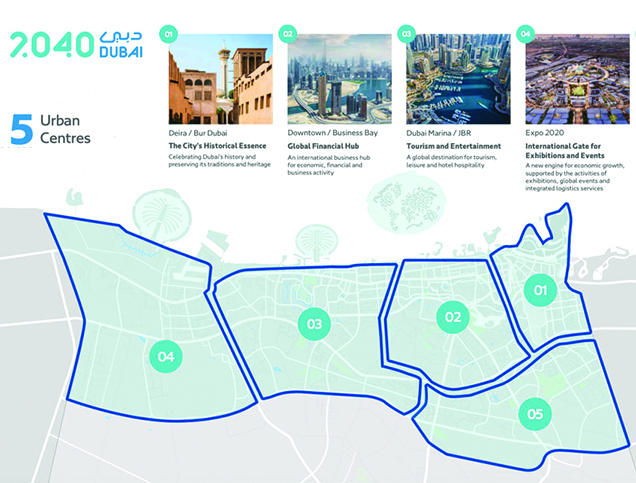
The initiative envisions “enhanced climate adaptation and flood-risk reduction, improved urban livability, and stronger water security” through integrated green infrastructure and smart urban systems aligned with the Dubai 2040 Urban Master Plan.3 The project adopts a city-scale planning and implementation approach and seeks to embed sponge-city principles across streets, public spaces, and developments. It aims at combining nature-based solutions with smart water technologies to capture and reuse rainwater, reduce surface runoff, and mitigate flooding risks in a rapidly urbanizing desert city.4
The initiative introduces a comprehensive urban water management and green infrastructure framework across the city. Key components include:5 6 7
The sponge city approach is designed to address climate change and rapid urbanization by transforming how cities manage rainfall and water resources. By capturing and reusing rainwater, the project helps reduce pressure on freshwater supplies while lowering flood risks and enhancing biodiversity in urban environments. The initiative is also expected to improve air quality, expand green spaces, and promote eco-friendly urban development, strengthening Dubai’s resilience to extreme weather and climate variability.8 9

Owner/Developer (Public)
Owner/Developer (Public)
The initiative is led by Dubai Municipality, with technical collaboration provided by the Urban Planning and Design Institute of Shenzhen (UPDIS) under a Memorandum of Understanding (MoU) focused on international k knowledge exchange.10 11 The partnership facilitates the transfer of sponge-city and climate-resilient urban planning expertise from Shenzhen to Dubai and is aligned with the Dubai 2040 Urban Master Plan and cooperation platforms associated with the World Governments Summit, supporting future-oriented, sustainable urban development.12 13
The initiative began with knowledge exchange phase in 2025, including Dubai delegation visits to Shenzhen to study sponge-city applications. In 2026, the cooperation was formalized through the MoU signing at the World Governments Summit, marking the official launch.14 Next phases focus on progressive integration of sponge-city principles into planning and implementation across Dubai in alignment with the Dubai 2040 Urban Master Plan.15
Project Link
Endnotes
N.A.
References
An online library where you can explore relevant data on urban development in the Arab cities.
More



Lorem ipsum dolor sit amet consectetur. Lacus nibh neque erat massa elementum. Ultricies ante sed sed nunc massa ider.
Last updated 3 mins ago
Lorem ipsum dolor sit amet consectetur. Lacus nibh neque erat massa elementum. Ultricies ante sed sed nunc massa ider.
Last updated 3 mins ago
Lorem ipsum dolor sit amet consectetur. Lacus nibh neque erat massa elementum. Ultricies ante sed sed nunc massa ider.
Last updated 3 mins ago
Lorem ipsum dolor sit amet consectetur. Lacus nibh neque erat massa elementum. Ultricies ante sed sed nunc massa ider.
Last updated 3 mins ago
Lorem ipsum dolor sit amet consectetur. Lacus nibh neque erat massa elementum. Ultricies ante sed sed nunc massa ider.
Last updated 3 mins ago
Lorem ipsum dolor sit amet consectetur. Lacus nibh neque erat massa elementum. Ultricies ante sed sed nunc massa ider.
Last updated 3 mins ago