Close
Approach Words: Strategic Planning
Public Policy Instruments: Regulatory
The Great Man-Made River (GMMR) is a national-scale water-infrastructure megaproject developed to serve Libya’s coastal regions,1 GMMR is widely recognized as the world’s largest irrigation and water-transfer system, comprising more than 4,000 kilometers of prestressed concrete cylinder pipelines that convey groundwater from inland desert aquifers to coastal population and agricultural zones. 2 3
The project’s vision is to “enhance the quality of life for all Libyan citizens”, by securing a reliable freshwater supply through the productive use of Libya’s vast underground aquifer systems. 4
It aims to address structural water scarcity by supplying potable water to coastal cities where most of the population is concentrated, reducing dependence on desalination, and supporting agricultural expansion.5 Mainly, to enable the irrigation of approximately 200,000 hectares of agricultural land, including both existing and newly reclaimed desert areas; thus, supporting national self-sufficiency in staple food production such as cereals, meat and dairy products. 6
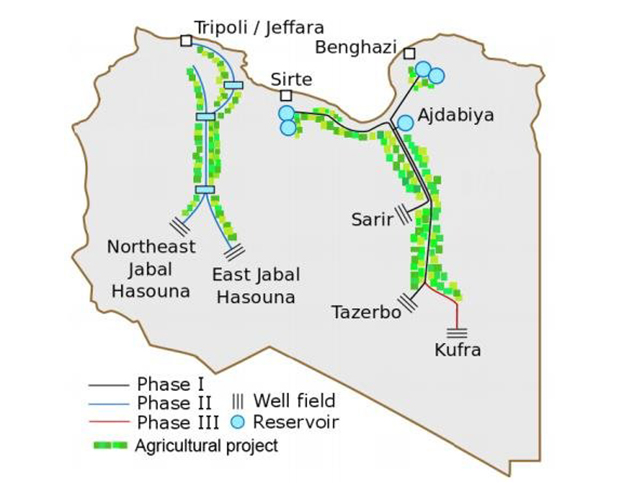
Title: Map of Great Man-Made River
Source: Click Here
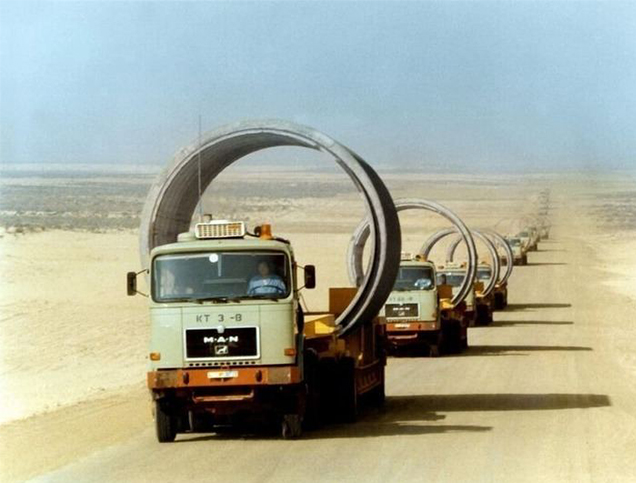
Title: Giant pipe segments for the Great Man-Made River project being transported across the Libyan desert
Source: Click Here
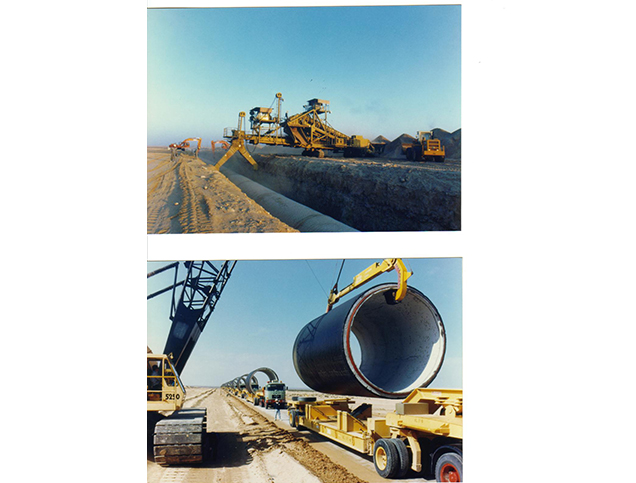
Title: A crane lifts a segment of the GMMR pipe for installation
Source: Click Here
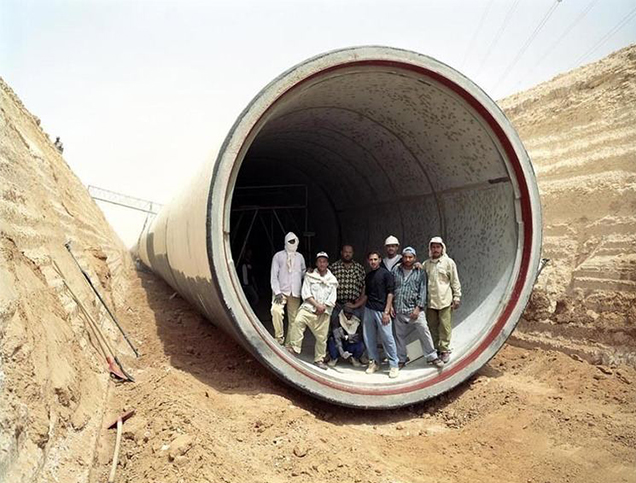
Title: construction workers standing inside a large-diameter segment of the PCCP pipeline for the Great Man-Made River
Source: Click Here
Title: Map of Great Man-Made River
Source: Click Here
Title: Giant pipe segments for the Great Man-Made River project being transported across the Libyan desert
Source: Click Here
Title: A crane lifts a segment of the GMMR pipe for installation
Source: Click Here
Title: construction workers standing inside a large-diameter segment of the PCCP pipeline for the Great Man-Made River
Source: Click Here
To implement its vision and these objectives, the GMMR comprises an integrated set of large-scale hydraulic components, including:
· More than 1,300 deep groundwater wells, most exceeding 500 meters in depth; 7
· A national transmission network of prestressed concrete cylinder pipelines, each approximately 7.5 meters in length, 4 meters in diameter, and 25 centimeters thickness; 8
· Nine agricultural reservoirs in the Tripoli region, each with a capacity of 86,000 cubic meters; 9
· The largest terminal storage reservoir located near Ajdabiya;10
· Multiple large-scale pumping stations supplied by international manufacturers through the Frankenthal KSB consortium; 11
· Two dedicated pipe-manufacturing plants in Brega and Sarir, each capable of producing up to 80 pipe segments per day. 12


Consultant/Designer

Consultant/Designer
At full operation, the system is designed to deliver up to 6.5 million cubic meters of fresh water per day for municipal, agricultural, and industrial uses. 13 14
The GMMR was developed as a state-funded strategic infrastructure program under public law, centralized planning, and direct government financing. It is owned, funded and operated by the Libyan Government through the Great Man-Made River Authority.15 16 Original project design was undertaken by Brown & Root and Price Brothers, with subsequent engineering and advisory roles by Nippon Koei/Halcrow consortium. 17 18 Construction and implementation involved multiple international contractors across different phases, including Dong Ah Construction Industrial, Enka Construction, and Al Nahr Company.19 20
The overall system is organized into five major development phases, extending across all the four Libyan regions: 21
· 1984: Project initiation 22
· 1991: Completion of the eastern coastal supply corridor, delivering 3.5 million cubic metres of daily water from southern well fields (Kufra, Tazirbo, and Sarir) to Sirte and Benghazi. 23 24
· 1996: Completion of the western coastal supply corridor, delivering 2.5 million cubic metres of daily water from Jabl El-Hesouna to the coastal corridor from Misrata to Zawia.2526
· Completion of preliminary engineering and design for subsequent phases.
· Later phases with partial implementation.
By 2011, more than 70percent of the project was completed. Subsequent progress was constrained by power shortages, security challenges, and political instability; however, operational segments continue to supply critical water to Tripoli, Benghazi, Sirte, and associated agricultural areas. 27
Upon full completion, the GMMR is intended to enable national water self-sufficiency, support large-scale agriculture, and remain a defining example of state-led mega-infrastructure in arid environments. 28
Project Link
Endnotes
References
An online library where you can explore relevant data on urban development in the Arab cities.
More




Lorem ipsum dolor sit amet consectetur. Lacus nibh neque erat massa elementum. Ultricies ante sed sed nunc massa ider.
Last updated 3 mins ago
Lorem ipsum dolor sit amet consectetur. Lacus nibh neque erat massa elementum. Ultricies ante sed sed nunc massa ider.
Last updated 3 mins ago
Lorem ipsum dolor sit amet consectetur. Lacus nibh neque erat massa elementum. Ultricies ante sed sed nunc massa ider.
Last updated 3 mins ago
Lorem ipsum dolor sit amet consectetur. Lacus nibh neque erat massa elementum. Ultricies ante sed sed nunc massa ider.
Last updated 3 mins ago
Lorem ipsum dolor sit amet consectetur. Lacus nibh neque erat massa elementum. Ultricies ante sed sed nunc massa ider.
Last updated 3 mins ago
Lorem ipsum dolor sit amet consectetur. Lacus nibh neque erat massa elementum. Ultricies ante sed sed nunc massa ider.
Last updated 3 mins ago