Close
Approach Words: Efficiency, Sustainability, Urban Livability
Public Policy Instruments: Physical Intervention, Planning
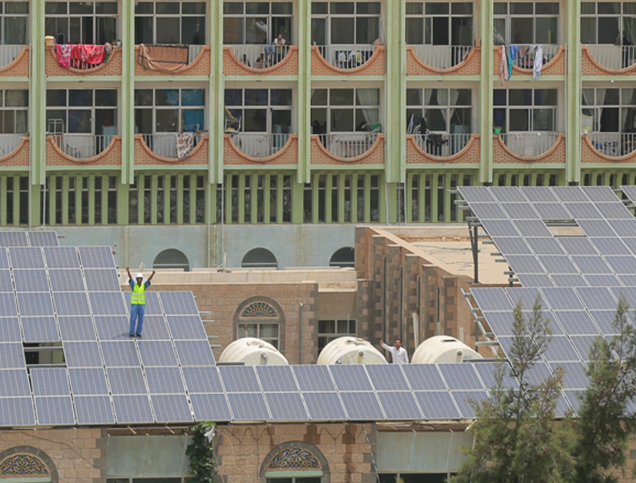
Al-Fashir Solar Plant is one of Sudan’s first utility-scale solar photovoltaic (PV) power installations, located in Al-Fashir, the capital of North Darfur. It marks as a key milestone in Sudan’s nascent renewable energy sector, representing the country’s first large-scale grid-connected solar farm.1 2
The project was developed to help address chronic electricity shortages in the Darfur region, improve local electrification, and contribute to diversifying Sudan’s electricity mix, historically dominated by hydropower and thermal generation.3
The programme vision is to “leverage Sudan’s abundant solar resource potential” to provide clean, sustainable, and cost-competitive electricity while reducing reliance on fossil-fuel generation and diesel-powered generators. The project aims to enhance energy security, decrease fuel import costs, and reduce greenhouse gas emissions in the region.4 It also seeks to act as a renewable practical solar investment in Sudan’s grid, build local capacity and support future renewable energy planning.5
Al-Fashir Solar Plant covers a flat terrain east of Al-Fashir city, with high average annual solar irradiation (~2,370 kWh/m²).6 It combines utility-scale PV generation with grid integration infrastructure, supplying clean electricity to the local grid in Al-Fashir and supporting residential and commercial demand in the Darfur region while maintaining stable integration with Sudan’s wider power system.7 8 9Its key components include:
Al-Fashir Solar Plant has generated measurable local benefits by reducing reliance on diesel-based electricity generation, lowering fuel costs and associated emissions.14 By introducing solar power, the project contributes to greenhouse gas mitigation while improving the reliability of electricity supply in a region with historically limited grid access, supporting local livelihoods and economic activity.15 16 Beside, during construction and operations, it created employment roles in panel maintenance and local services.17

Owner/Developer (Public)

Contractor/Implementer
Owner/Developer (Public)
Contractor/Implementer
The project is coordinated by the Government of Sudan through the Ministry of Electricity, which leads planning, financing, and deployment in line with national renewable energy policy.18 Grid integration and operational oversight are managed by the Sudan Electricity Holding Company and local utility entities.19 Technical delivery involves consultants, engineers, and EPC contractors responsible for design, construction, and commissioning, although specific firms are not widely disclosed in public sources.20 It is primarily financed by the Sudanese federal government, with an estimated investment of approximately USD 6.8 million, reflecting early national commitment to renewable energy infrastructure.21
Al-Fashir Solar Plant was commissioned in 2019 and has been fully operational and integrated into the local grid since 2025.22 23 The project represents a foundational step in Sudan’s renewable energy landscape, supporting early solar deployment alongside national plans to expand solar and wind capacity to address long-standing electricity shortages.24
Project Link
Endnotes
N.A.
References
An online library where you can explore relevant data on urban development in the Arab cities.
More



Lorem ipsum dolor sit amet consectetur. Lacus nibh neque erat massa elementum. Ultricies ante sed sed nunc massa ider.
Last updated 3 mins ago
Lorem ipsum dolor sit amet consectetur. Lacus nibh neque erat massa elementum. Ultricies ante sed sed nunc massa ider.
Last updated 3 mins ago
Lorem ipsum dolor sit amet consectetur. Lacus nibh neque erat massa elementum. Ultricies ante sed sed nunc massa ider.
Last updated 3 mins ago
Lorem ipsum dolor sit amet consectetur. Lacus nibh neque erat massa elementum. Ultricies ante sed sed nunc massa ider.
Last updated 3 mins ago
Lorem ipsum dolor sit amet consectetur. Lacus nibh neque erat massa elementum. Ultricies ante sed sed nunc massa ider.
Last updated 3 mins ago
Lorem ipsum dolor sit amet consectetur. Lacus nibh neque erat massa elementum. Ultricies ante sed sed nunc massa ider.
Last updated 3 mins ago