Close
Approach Words: Diverse Economy
Public Policy Instruments: Organization
The Greater Tortue Ahmeyim (GTA) liquefied natural gas (LNG) project is a strategic offshore development located at the maritime border between Mauritania and Senegal,approximately 120 kilometers offshore in ultra-deep waters reaching 2,850 meters. 1 2 GTA is one of Africa’s most technically advanced offshore gas developments. 3 Following a final investment decision in December 2018, construction commenced shortly thereafter, positioning GTA as a foundation of both countries’ long-term energy and economic strategies. 4
The project’s vision is to “monetize the GTA gas field in support of long-term economic transformation, energy security, and fiscal stability” in both Mauritania and Senegal. GTA LNG project aims to develop an estimated 15 trillion cubic feet of recoverable natural gas across a reserve area of 33,000 square kilometers,5 supplying LNG to global markets while supporting domestic energy systems.6 For Mauritania alone, projected government revenues are estimated at USD 19 billion dollars over 30 years,7 and to establish both countries as a new LNG-exploring countries, generate sustained government revenues, and leverage natural gas as a transition fuel, as well as highlighting the project’s macroeconomic significance. 8 In July 2021, both governments formally designated the GTA LNG as a project of strategic national importance.9 10
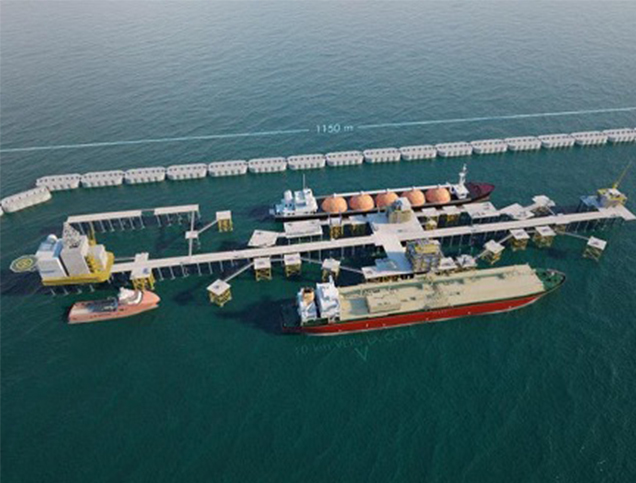
Title: The Greater Tortue Ahmeyim LNG project is expected to commence production in 2022. Image courtesy of Eiffage.
Source: Click Here
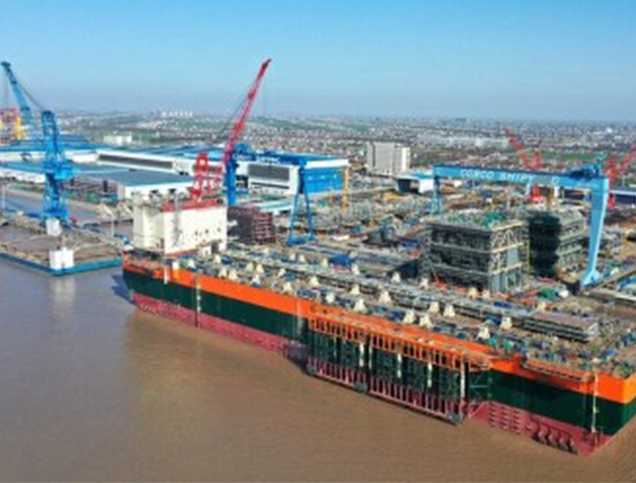
Title: A massive FPSO (Floating Production, Storage, and Offloading) unit undergoes integration at a COSCO Shipping shipyard, destined for the Greater Tortue Ahmeyim (GTA) LNG project to facilitate hydrocarbon processing and export.
Source: Click Here
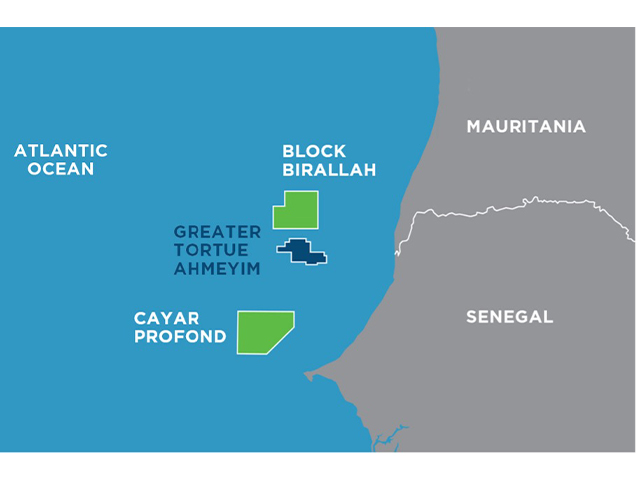
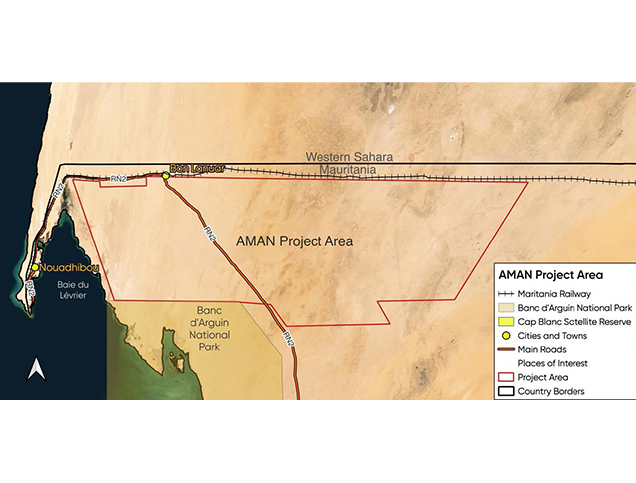
Title: Geospatial map of the Greater Tortue Ahmeyim field located at the Mauritania-Senegal maritime border.
Source: Click Here
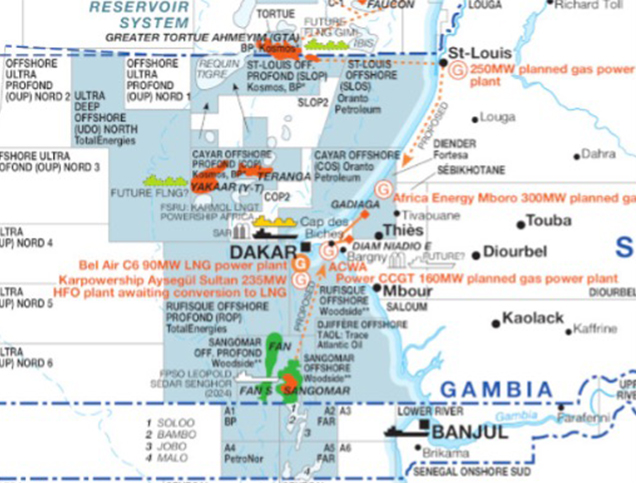
Title: Map showing offshore gas blocks, including Greater Tortue Ahmeyim, Cayar Profond, and Block Birallah, across the Mauritania-Senegal maritime border.
Source: Click Here
Title: The Greater Tortue Ahmeyim LNG project is expected to commence production in 2022. Image courtesy of Eiffage.
Source: Click Here
Title: A massive FPSO (Floating Production, Storage, and Offloading) unit undergoes integration at a COSCO Shipping shipyard, destined for the Greater Tortue Ahmeyim (GTA) LNG project to facilitate hydrocarbon processing and export.
Source: Click Here
Title: Geospatial map of the Greater Tortue Ahmeyim field located at the Mauritania-Senegal maritime border.
Source: Click Here
Title: Map showing offshore gas blocks, including Greater Tortue Ahmeyim, Cayar Profond, and Block Birallah, across the Mauritania-Senegal maritime border.
Source: Click Here
To implement this vision, the GTA LNG project is delivered through a cross-border public-private partnership (PPP) framework, underpinned by bilateral treaties, national hydrocarbons legislation, and shared governance mechanisms between Mauritania and Senegal. 11 Key components of the project include: 12
· A Floating Production Storage, and Offloading (FPSO) vessel for upstream gas processing and liquids separation (270 meters in length, 54 meters in width, and 31.5 meters in height). 13
· The FLNG Gimi floating liquefaction facility, operated under a 20-year lease and operate agreement,14
· Subsea production infrastructure, including a four-well connection system with pipelines transporting gas from the seabed to surface facilities,15
· A gravity-based structure (GBS) supporting nearshore operations and export infrastructure. 16
Together, these systems enable offshore production, liquefaction, storage, and export without the need for onshore LNG terminals, reducing land-based environmental and social impacts.
The GTA LNG Project integrates multiple sustainability measures, utilizing natural gas as a low-carbon transition fuel. A hybrid power generation system combining gas turbines and renewable energy is designed to reduce operational emissions by approximately 15 percent, while carbon capture and storage (CCS)-ready infrastructure is expected to mitigate up to 200,000 tons of Carbon Dioxide (CO₂) annually. 17 Beyond emissions reduction, the project supports cleaner energy access and fuel alternatives in Senegal and Mauritania, where almost 60 percent of the population have historically relied on higher-emission energy sources. 18

Owner/Developer
Owner/Developer
The GTA LNG project holds socio-economic contributions that extend beyond direct resource extraction and energy revenues. Its impact framework is structured around employment creation, capacity building and local workforce development, community investment, and institutional strengthening in both Mauritania and Senegal. From a workforce perspective, GTA generated approximately 10,000 direct and indirect jobs during the construction phase, representing one of the largest sources of near-term employment in the sub-region.19 A national content strategy has been established to progressively increase the share of local employment and procurement, with long-term operational jobs projected to create sustained livelihoods in engineering, operations, logistics, and technical services.20 Skills development forms a central pillar of the project’s implementation model. Workforce training programs, delivered in collaboration with national technical institutes, are designed to support the transition of local labor into specialized gas industry roles, with an emphasis on long-term occupational pathways rather than short-term engagement.21
The project also supports community infrastructure development through targeted social investment, including improvements to health facilities, water supply systems, educational institutions, and coastal livelihoods programs for fishing communities near offshore operations.22 These initiatives are co-designed with local stakeholders to ensure alignment with community priorities and regional development objectives.23 A transparent monitoring framework tracks implementation progress and includes mechanisms for stakeholder feedback, as required under both national legislation and international finance guidelines.24
From an institutional development perspective, GTA contributes to strengthening regulatory and operational capacity within Mauritania’s and Senegal’s hydrocarbon sectors, supporting long-term governance frameworks for resource management and energy policy development.25 By establishing supply chain networks, technical training systems, and operational infrastructure, the project is positioned to serve as a platform for future energy sector development and regional integration.26 The GTA LNG project’s broader value proposition lies in its role as a multi-dimensional development initiative that links offshore resource extraction to measurable socio-economic and institutional outcomes, framing natural gas development as a catalyst for structural transformation rather than a stand-alone commodity export activity.27 28
Project Link
https://www.kosmosenergy.com/greater-tortue/
Endnotes
1Kosmos Energy (2024) Greater Tortue Ahmeyim. Available at: https://www.kosmosenergy.com/greater-tortue/
2 NS Energy (2024) Greater Tortue Ahmeyim LNG Project, Maritime Border, Mauritania and Senegal. Available at: https://www.nsenergybusiness.com/projects/greater-tortue-ahmeyim-lng-project/
3WADR (2020) Mauritania-Senegal: A look at the Greater Tortue Ahmeyim gas project. Available at: https://www.wadr.org/mauritania-senegal-a-look-at-the-greater-tortue-ahmeyim-gas-project/
4Kosmos Energy (2018) Kosmos Energy announces Final Investment Decision for Greater Tortue Ahmeyim Phase 1 Project. Available at: https://www.kosmosenergy.com/wp-content/uploads/2024/03/181221_KOS_PR_Greater-Tortue-Final-Investment-Decision-1.pdf
5Kosmos Energy (2024) Greater Tortue Ahmeyim. Available at: https://www.kosmosenergy.com/greater-tortue/
6British Petroleum (2023) Greater Tortue Ahmeyim. Available at: https://www.bp.com/en/global/corporate/what-we-do/gas-and-low-carbon-energy/greater-tortue-ahmeyim.html
7Société Mauritanienne des Hydrocarbures (2024) Greater Tortue Ahmeyim. Available at: http://www.smhpm.mr/projets/greater-tortue-ahmeyim/
8Offshore Energy (2023) First gas from Greater Tortue Ahmeyim on target despite FPSO delay. Available at: https://www.offshore-energy.biz/first-gas-from-greater-tortue-ahmeyim-on-target-despite-fpso-delay/
9Société Mauritanienne des Hydrocarbures (2021) Mauritania and Senegal signed the declaration on strategic importance of the Greater Tortue Ahmeyim project. Available at: http://www.smhpm.mr/actualites/mauritanie-et-senegal-ont-signe-la-declaration-sur-limportance-strategique-du-projet-gta/
10Africa Energy (2021) Mauritania, Senegal to support gas deals. Available at: https://www.africa-energy.com/news-centre/article/mauritania-senegal-to-support-gas-deals
11NS Energy (2024) Greater Tortue Ahmeyim LNG Project, Maritime Border, Mauritania and Senegal. Available at: https://www.nsenergybusiness.com/projects/greater-tortue-ahmeyim-lng-project/
12Kosmos Energy (2024) Greater Tortue Ahmeyim. Available at: https://www.kosmosenergy.com/greater-tortue/
13COSCO Shipping (2023) COSCO SHIPPING Heavy Industry (Qidong) celebrates the naming and delivery ceremony of Greater Tortue Ahmeyim FPSO. Available at: https://en.coscoshipping.com/art/2023/4/26/art_7791_223363.html
14Golar LNG (2024) Greater Tortue Ahmeyim FLNG. Available at: https://www.golarlng.com/fleet/flng-gimi/
15TechnipFMC (2024) Greater Tortue Ahmeyim. Available at: https://www.technipfmc.com/en/what-we-do/projects/greater-tortue-ahmeyim/
16Eiffage (2024) Greater Tortue Ahmeyim (GTA). Available at: https://www.eiffage.com/en/projet/greater-tortue-ahmeyim-gta
17British Petroleum (2023) Greater Tortue Ahmeyim. Available at: https://www.bp.com/en/global/corporate/what-we-do/gas-and-low-carbon-energy/greater-tortue-ahmeyim.html
18International Energy Agency (2022) Senegal Energy Profile. Available at: https://www.iea.org/countries/senegal
19Société Mauritanienne des Hydrocarbures (2024) Greater Tortue Ahmeyim. Available at: http://www.smhpm.mr/projets/greater-tortue-ahmeyim/
20British Petroleum (2024) Working with communities. Available at: https://www.bp.com/en/global/corporate/sustainability/getting-to-net-zero/working-with-our-communities.html
21Kosmos Energy (2023) Social Performance Report 2023. Available at: https://www.kosmosenergy.com/responsibility/social-performance/
22British Petroleum (2024) Working with communities. Available at: https://www.bp.com/en/global/corporate/sustainability/getting-to-net-zero/working-with-our-communities.html
23Kosmos Energy (2023) Social Performance Report 2023. Available at: https://www.kosmosenergy.com/responsibility/social-performance/
24International Finance Corporation (2024) IFC Advisory Services in Oil, Gas & Mining. Available at: https://www.ifc.org/en/what-we-do/sector/oil-gas-and-mining
25Société Mauritanienne des Hydrocarbures (2024) Institutional Framework. Available at: http://www.smhpm.mr/institutional-framework/
26PETROSEN (2024) Strategy and Development. Available at: http://www.petrosen.sn/strategy-and-development/
27Africa Energy (2024) Mauritania, Senegal: GTA and Sangomar developers eye new projects. Available at: https://www.africa-energy.com/news-centre/article/mauritania-senegal-gta-and-sangomar-developers-eye-new
28Kosmos Energy (2024) Greater Tortue Ahmeyim. Available at: https://www.kosmosenergy.com/greater-tortue/
29PETROSEN (2024) About PETROSEN. Available at: http://www.petrosen.sn
30Société Mauritanienne des Hydrocarbures (2024) About SMH. Available at: http://www.smhpm.mr/
31Ministry of Petroleum, Energy and Mines of Mauritania (2024) About the Ministry. Available at: http://www.petroleum.gov.mr/
32British Petroleum (2023) Greater Tortue Ahmeyim. Available at: https://www.bp.com/en/global/corporate/what-we-do/gas-and-low-carbon-energy/greater-tortue-ahmeyim.html
References
An online library where you can explore relevant data on urban development in the Arab cities.
More



Lorem ipsum dolor sit amet consectetur. Lacus nibh neque erat massa elementum. Ultricies ante sed sed nunc massa ider.
Last updated 3 mins ago
Lorem ipsum dolor sit amet consectetur. Lacus nibh neque erat massa elementum. Ultricies ante sed sed nunc massa ider.
Last updated 3 mins ago
Lorem ipsum dolor sit amet consectetur. Lacus nibh neque erat massa elementum. Ultricies ante sed sed nunc massa ider.
Last updated 3 mins ago
Lorem ipsum dolor sit amet consectetur. Lacus nibh neque erat massa elementum. Ultricies ante sed sed nunc massa ider.
Last updated 3 mins ago
Lorem ipsum dolor sit amet consectetur. Lacus nibh neque erat massa elementum. Ultricies ante sed sed nunc massa ider.
Last updated 3 mins ago
Lorem ipsum dolor sit amet consectetur. Lacus nibh neque erat massa elementum. Ultricies ante sed sed nunc massa ider.
Last updated 3 mins ago