Close
Approach Words: Sustainability
Public Policy Instruments: Infrastructure
The Benban Solar Park is a landmark renewable energy initiative in the Aswan governorate of Upper Egypt. It is the largest solar park in Africa and one of the largest globally, with a total installed capacity of 1.8GW.1 2 The project was launched under Egypt’s 2014 Feed-in Tariff (FiT) Framework, aimed at reducing dependence on fossil fuels and accelerate the transition to renewable energy.
Its vision is “to support Egypt’s Sustainable Energy Strategy 2035”, which sets a target of generating 20% of electricity from renewables by 2022.3
The project aims to produce more than 4TWh of electricity annually, supply power to over 350,000 households, and reduce CO2 emissions by more than 1.9 million tonnes per year.45
The project is part of Egypt’s Nubian Suns Renewable Energy Feed-in Tariff (FiT) programme announced in September 2014.6
To achieve the vision, the Benban Solar Park spans 37.2 square kilometers of desert land north of Aswan.78 Its major components include:
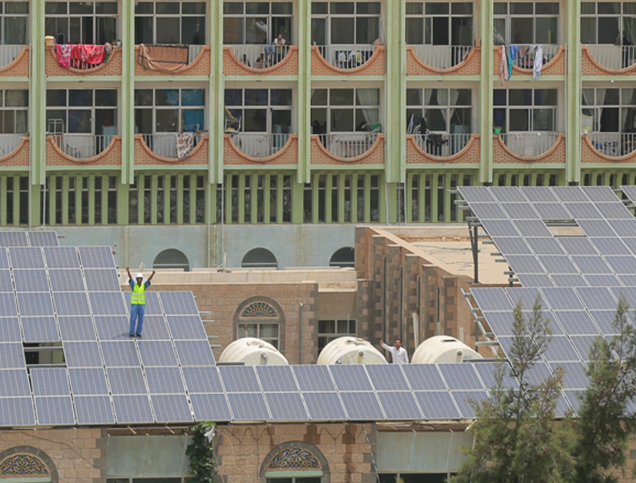
In terms of sustainability, the solar park employs advanced technologies such as bifacial modules in 6 projects (totalling 300 MW), which generate electricity from both direct sunlight and ground-reflected light.14 Photovoltaic panels are installed on fixed frames in large arrays, while a centralized control center monitors system performance and coordinates transmission. 15
The project is managed and implemented by key stakeholders. Egyptian authorities, particularly NREA and EETC, provide regulatory and infrastructure support,16 17 while financing is from international institutions including the European Bank for Reconstruction and Development (EBRD), the International Financial Corporation (IFC), and other global development banks. The EBRD alone finances 750 MW across 16 projects, at a cost of USD 1.13 billion.18 19
Construction progressed in multiple phases, and the solar park was fully completed in 2019. 2021 Today, the Benban Solar Park is recognized as a huge achievement in Egypt’s clean energy transition. It strengthens national energy security, positions Egypt as a leader in large-scale solar development, and creates substantial employment opportunities in Upper Egypt, while contributing to global climate change mitigation efforts.22 23


Consultant/Designer

Consultant/Designer
Project Link
Endnotes
References
An online library where you can explore relevant data on urban development in the Arab cities.
More




Lorem ipsum dolor sit amet consectetur. Lacus nibh neque erat massa elementum. Ultricies ante sed sed nunc massa ider.
Last updated 3 mins ago
Lorem ipsum dolor sit amet consectetur. Lacus nibh neque erat massa elementum. Ultricies ante sed sed nunc massa ider.
Last updated 3 mins ago
Lorem ipsum dolor sit amet consectetur. Lacus nibh neque erat massa elementum. Ultricies ante sed sed nunc massa ider.
Last updated 3 mins ago
Lorem ipsum dolor sit amet consectetur. Lacus nibh neque erat massa elementum. Ultricies ante sed sed nunc massa ider.
Last updated 3 mins ago
Lorem ipsum dolor sit amet consectetur. Lacus nibh neque erat massa elementum. Ultricies ante sed sed nunc massa ider.
Last updated 3 mins ago
Lorem ipsum dolor sit amet consectetur. Lacus nibh neque erat massa elementum. Ultricies ante sed sed nunc massa ider.
Last updated 3 mins ago