

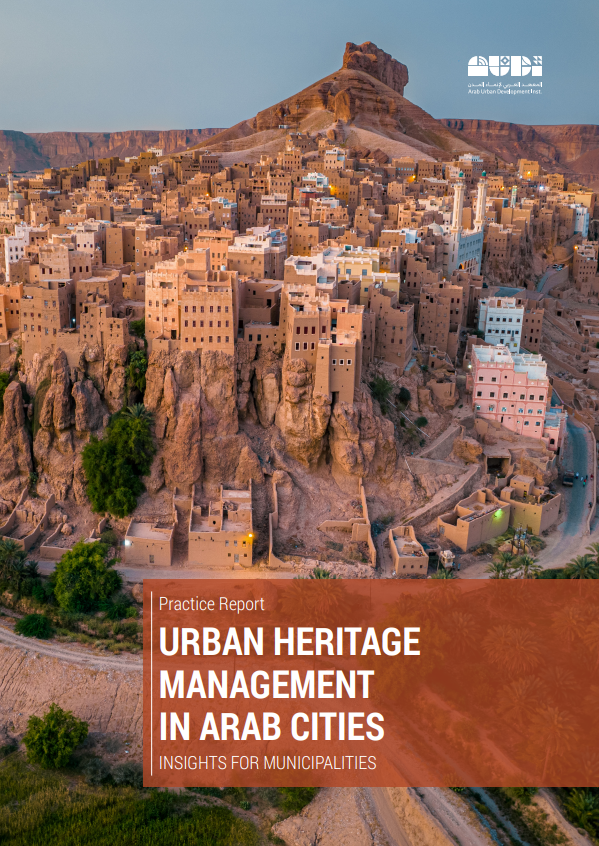
The archaeological evidence in Arab cities stands as a testament to their close connection to heritage. The finest examples of this are the masterpieces of Egypt, the majestic Islamic architecture of the holy lands of the Hejaz, and the rich cultural heritage of the Maghreb. Retaining and strengthening this connection, therefore, becomes a key agenda for cities across the region. However, the process by which each municipality or local government entity governs and manages its heritage varies depending on both the heritage type, and on the city’s legal, political and socio-economic context.
This report on Urban Heritage Management in Arab Cities has been produced with the aim of providing insights to municipalities on policies and practices prevalent in the region in the domain of urban heritage management. It is rooted in a comprehensive understanding of the concept of heritage as a social, cultural, and economic asset, that is preserved from the past not only to serve as a memory but also as a means to shaping the future. There are various approaches adopted internationally when it comes to the management of heritage, with the predominant one being the ‘Historic Urban Landscape’ approach that focuses on the integration of heritage management and policies with the overarching goals of sustainable urban development. As a municipal responsibility, the management of heritage management relies heavily on an adept governance system that is well integrated with other sectors and functions in alignment with an appropriate legal, political, and financial framework. In the case of the Arab region, UNESCO’s World Heritage List includes 26 cities and towns from Middle East and North Africa alone. The challenges faced by Arab cities when it comes to the management of their heritage vary depending on social, political, and economic context. These include issues related to infrastructure and services, rapid urbanization, gentrification, urban poverty, lack of regulation and others.
Through an in-depth study of 9 cities in the Arab region, this report highlights innovative and local approaches to heritage management that have been adopted by across the 9 cities and are relevant to others in the region. Approaches such as the participatory heritage policies and practices of Tunisia and Morocco, post-conflict regeneration in Iraq, linking of heritage to climate action in the Sudan, integration of local communities in the management of heritage in Oman, the growing class of independent conservation professionals in Egypt, targeted investment in heritage management and revitalization in the Gulf, and the building of consensus around the value of heritage in Jordan all represent the diversity of practices prevalent in the Arab region.
Each case study provides insights into the city’s unique heritage context, the legislative and regulatory framework that governs it, and the major issues it faces. This is followed by an in-depth discussion of a specific project or initiative in the respective city and the key lessons learned from the process by which the initiative was implemented.
Furthermore, the report uses these case studies as a backdrop to engage the reader in an insightful discussion on how cities can manage their urban heritage. This discourse is presented through three key levels of city management, namely the institutional vision and policy level, the strategic level, and the managerial level. A series of recommendations are also presented at each level, focusing on a range of concerns including the right to heritage, the need for tailoring international urban heritage frameworks to the local context, the vital role played by Conservation Management Plans, the importance of academic and vocational training programs, and the value of participatory frameworks. By shedding light on the diverse experiences and strategies adopted by cities across the region, this report serves as a valuable resource for policymakers, urban planners, and heritage professionals striving to preserve and integrate urban heritage within contemporary cityscapes. It highlights the importance of fostering inclusive and adaptive governance models that ensure heritage conservation is not seen as a constraint to development but rather as a catalyst for innovation, social cohesion, and economic prosperity.
Publications


Arab Cities Information Hub
An online library where you can explore relevant data on urban development in the Arab cities.
More


Upcoming Events


Lorem ipsum dolor sit amet consectetur.
Lorem ipsum dolor sit amet consectetur. Lacus nibh neque erat massa elementum. Ultricies ante sed sed nunc massa ider.
Last updated 3 mins ago
Lorem ipsum dolor sit amet consectetur.
Lorem ipsum dolor sit amet consectetur. Lacus nibh neque erat massa elementum. Ultricies ante sed sed nunc massa ider.
Last updated 3 mins ago
Lorem ipsum dolor sit amet consectetur.
Lorem ipsum dolor sit amet consectetur. Lacus nibh neque erat massa elementum. Ultricies ante sed sed nunc massa ider.
Last updated 3 mins ago
Lorem ipsum dolor sit amet consectetur.
Lorem ipsum dolor sit amet consectetur. Lacus nibh neque erat massa elementum. Ultricies ante sed sed nunc massa ider.
Last updated 3 mins ago
Lorem ipsum dolor sit amet consectetur.
Lorem ipsum dolor sit amet consectetur. Lacus nibh neque erat massa elementum. Ultricies ante sed sed nunc massa ider.
Last updated 3 mins ago
Lorem ipsum dolor sit amet consectetur.
Lorem ipsum dolor sit amet consectetur. Lacus nibh neque erat massa elementum. Ultricies ante sed sed nunc massa ider.
Last updated 3 mins ago

