
Back
AUDI Holds its 20th Webinar on “How Close Is the City to Its Residents? The Cognitive City and the ‘15-Minute’ Index: Insights from Riyadh Municipality’s Experience”
31 Mar 2026
As part of its ongoing commitment to inclusive urban planning, the Arab Urban Development Institute (AUDI) today held the 20th session of its “Cities in Action” webinar series, focusing on the theme “How Close Is the City to Its Residents? The Cognitive City and the ‘15-Minute’ Index: Insights from Riyadh Municipality’s Experience.” The session brought together a diverse group of specialists and professionals working in urban development to discuss practical strategies for making Arab cities more accessible and inclusive for all segments of society.
The webinar opened with welcoming remarks by Dr. Abdulla Difalla, the webinar moderator and professor of urban planning. He emphasized the significance of the topic amid rapid urban change, stressing the need to rethink the relationship between people and cities to improve quality of life and create more human-centered urban environments.
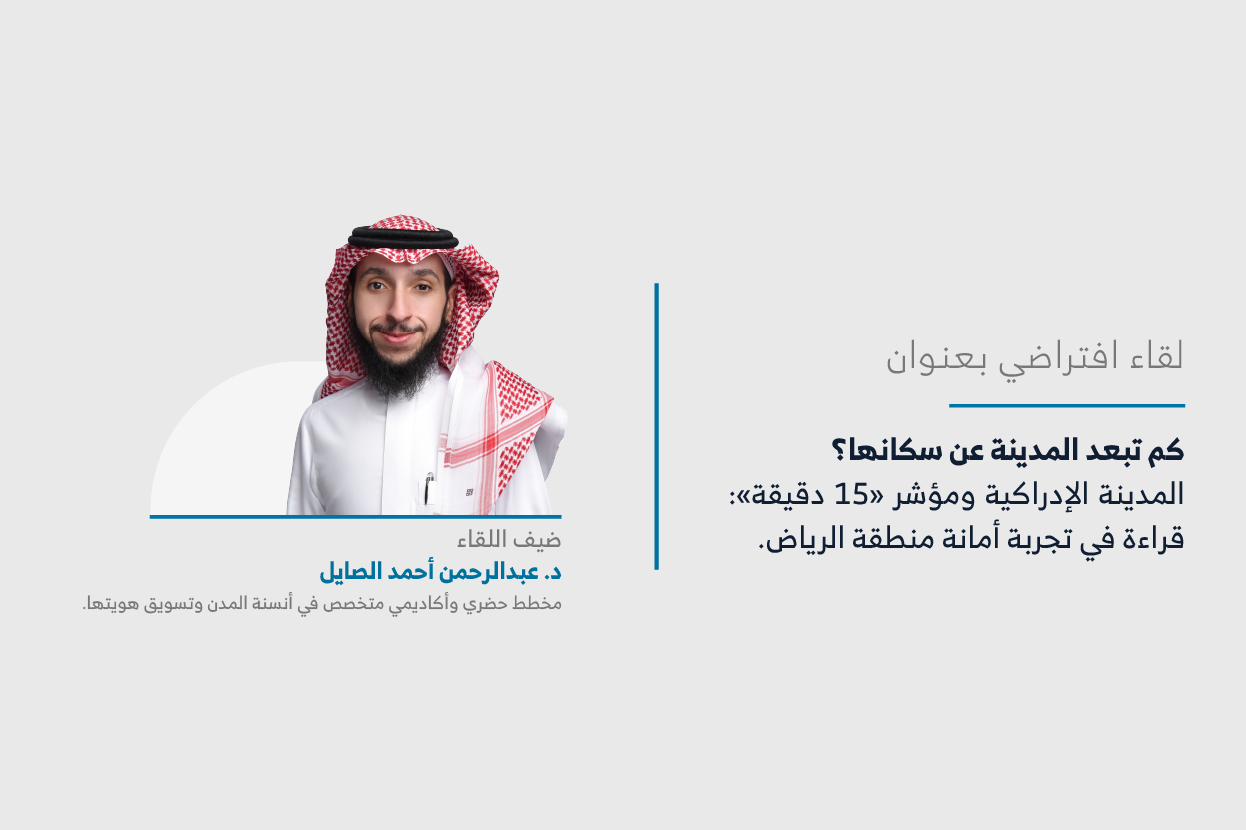
The webinar featured H.E. Dr. Abdulrahman Ahmed Nasser Alsayel, an urban planner and academic focused on humanizing cities and shaping their distinctive identity. He discussed the concept of the “distance crisis” in modern cities, noting that the issue extends beyond how near or far services are, and instead concerns the quality of everyday urban experiences and their ability to promote social interaction and strengthen human connections.
Dr. Al-Sayel also explored the concept of the “cognitive city” as an evolution of the smart city. He explained that its role goes beyond data collection and system operation to include a deeper understanding of what this data means and how it affects people’s lives. He noted that shifting the focus from “What is happening?” to “Why is it happening?” captures the core of this transformation in urban planning.
He also introduced the concept of the “15-minute city,” which seeks to organize daily life at the neighborhood level, so residents can meet their essential needs within a short distance. The approach aims not only to reduce travel time, but also to improve quality of life, encourage everyday interactions, and strengthen social cohesion.
He further highlighted the experience of the Riyadh Municipality in leveraging urban data through its Urban Data Center, indicating to its role in analyzing city indicators across areas such as urban development, population, services, transportation, environment, and human-centered planning—ultimately supporting more informed decision-making and guiding urban development with greater precision and efficiency.
He also addressed the challenges of relying on indicators and data, cautioning against focusing solely on improving metrics without enhancing residents’ real experiences. He highlighted the risk of “false proximity,” where services may appear nearby but are practically inaccessible. He stressed the need to integrate quantitative analysis with the human and qualitative aspects of urban planning.
Concluding his presentation, Dr. Al-Sayel emphasized that data serves as a tool to understand the city, not a replacement for decision-making, and that a city’s success should be measured not just by technological advancement but by its ability to foster humane and cohesive urban environments.
Following this, Eng. Wael Al-Shamrani from the Riyadh Municipality presented the Urban Data Center’s work, highlighting its indicators platform and interactive dashboards. He explained how the center monitors and analyzes over 160 urban indicators across various aspects of Riyadh’s development, including the “15-minute” indicator and its practical use in evaluating service accessibility within neighborhoods.
Dr. Abdulla Difalla closed the webinar by thanking Dr. Al-Sayel and Eng. Wael Al-Shamrani for their insightful scientific and practical contributions, noting that their presentations provide valuable guidance for refining planning principles and enhancing cities’ ability to improve quality of life.