

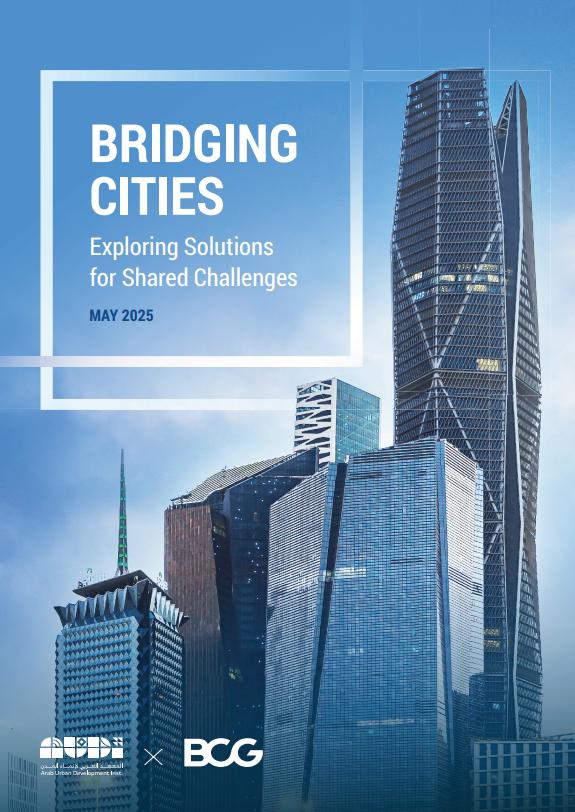
The Bridging Cities report, produced by the Arab Urban Development Institute (AUDI) in partnership with the Boston Consulting Group (BCG), explores how city-to-city (C2C) collaboration can help urban centers in the Arab and European regions tackle shared challenges. Framed around the Arab European Cities Dialogue (AECD), the report focuses on three interconnected priorities: climate resilience, digital transformation, and municipal finance.
On climate resilience, the report highlights the growing exposure of cities to heatwaves, water scarcity, flooding, and extreme weather events, which increasingly strain infrastructure, public health, and local economies. It emphasizes the role of C2C cooperation in accelerating adaptation and mitigation by enabling cities to exchange practical solutions on climate-responsive urban planning, nature-based interventions, resilient infrastructure, and access to climate finance. Case examples from cities across both regions demonstrate how shared climate data, risk-informed decision-making, and peer learning can strengthen long-term urban resilience.
On digital transformation, the report highlights cities’ shift from siloed digital efforts to more integrated, AI-enabled “cognitive cities.” Case studies from Dubai, Abu Dhabi, and Amsterdam showcase how cities are using AI, data monetization, and citizen-centric platforms to improve service delivery and transparency.
Municipal finance emerges as a critical enabler across all domains. Many cities remain heavily reliant on national transfers and grants. The report outlines strategies to enhance fiscal autonomy, such as performance-based budgeting, public-private partnerships, land value capture, and asset monetization. Examples from Sofia, Dubai, and Riyadh demonstrate how cities can fund urban development more sustainably.
A core message of the report is the transformative potential of C2C cooperation. It categorizes six engagement models, from symbolic partnerships to joint project delivery, and outlines five principles for effective collaboration: shared strategic goals, clear governance, complementary capabilities, joint financing, and sustained institutional support.
Ultimately, Bridging Cities positions inter-city collaboration as a powerful lever for accelerating urban innovation, resilience, and inclusion in a globally connected future.

Arab Cities Information Hub
An online library where you can explore relevant data on urban development in the Arab cities.
More







Upcoming Events


Lorem ipsum dolor sit amet consectetur.
Lorem ipsum dolor sit amet consectetur. Lacus nibh neque erat massa elementum. Ultricies ante sed sed nunc massa ider.
Last updated 3 mins ago
Lorem ipsum dolor sit amet consectetur.
Lorem ipsum dolor sit amet consectetur. Lacus nibh neque erat massa elementum. Ultricies ante sed sed nunc massa ider.
Last updated 3 mins ago
Lorem ipsum dolor sit amet consectetur.
Lorem ipsum dolor sit amet consectetur. Lacus nibh neque erat massa elementum. Ultricies ante sed sed nunc massa ider.
Last updated 3 mins ago
Lorem ipsum dolor sit amet consectetur.
Lorem ipsum dolor sit amet consectetur. Lacus nibh neque erat massa elementum. Ultricies ante sed sed nunc massa ider.
Last updated 3 mins ago
Lorem ipsum dolor sit amet consectetur.
Lorem ipsum dolor sit amet consectetur. Lacus nibh neque erat massa elementum. Ultricies ante sed sed nunc massa ider.
Last updated 3 mins ago
Lorem ipsum dolor sit amet consectetur.
Lorem ipsum dolor sit amet consectetur. Lacus nibh neque erat massa elementum. Ultricies ante sed sed nunc massa ider.
Last updated 3 mins ago

