

AUDI Holds its 16th Webinar on Aleppo’s Recovery Master Plan: Challenges and Pathways Forward
Riyadh, August 31, 2025
As part of its ongoing commitment to promoting inclusive urban planning across the Arab Region, the Arab Urban Development Institute (AUDI) held, today, the 16th session of its “Cities in Action” series, bringing together a wide range of specialists and professionals in urban development.
Dr. Abdullah Daifallah, the webinar moderator and professor of urban planning, opened the session with an overview of the “Cities in Action” series, underscoring its role in fostering discussions among specialists and urban development experts across the Arab region.
The session began with a speech by Eng. Lina Kuteifane, Director of World Heritage Sites at the Directorate-General of Antiquities and Museums (DGAM) in Syria, who outlined the current situation in the Old City of Aleppo and highlighted the administrative, social, and economic challenges it faces during ongoing reconstruction efforts.
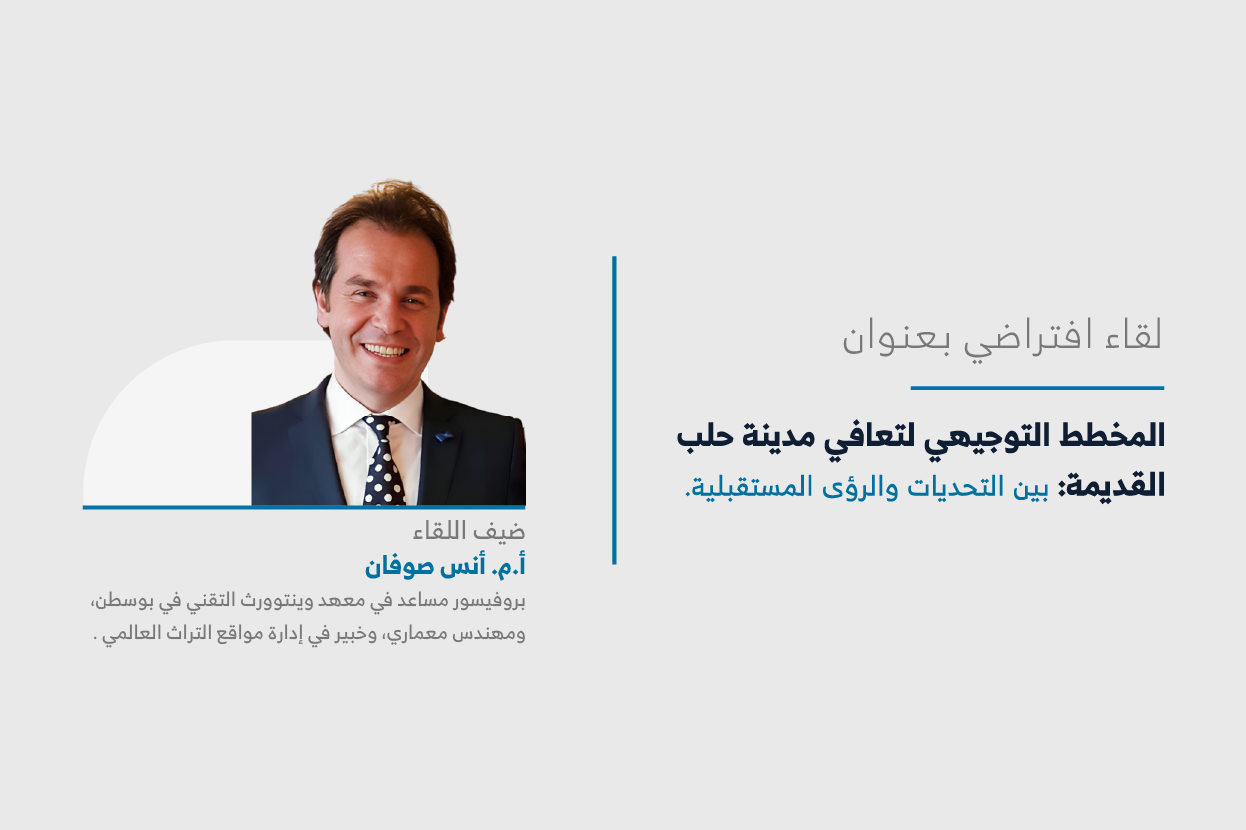
Dr. Anas Soufan, Assistant professor at Wentworth Institute of Technology-Boston, associate researcher, Architect, and World Heritage Management Specialist delivered a detailed presentation titled “Aleppo’s Recovery Master Plan: Challenges and Pathways Forward”.
In his presentation, Dr. Soufan outlined the main features of the master plan, developed in cooperation with local and international partners, highlighting its strategic framework for urban recovery. The plan strikes to balance the preservation of Aleppo’s historic fabric with the creation of a modern urban environment that meets residents’ aspirations. He stressed that the framework is built on two interlinked pathways: preservation—safeguarding the city’s heritage and identity—and development—ensuring basic services delivery, affordable housing, and economic and social opportunities that reinforce residents’ ties to their city.
He noted that the plan relies heavily on community participation and is designed with a multi-layered vision—starting from the regional framework of Greater Aleppo and narrowing down to neighborhoods and individual architectural elements. This approach, he explained, allows recovery projects to be coordinated and integrated across different levels. He added that real success will depend on fostering transparency and participation, as well as securing backing from international organizations and donors.
Dr. Soufan closed the session by stressing that recovery is about more than rebuilding structures—it is about reviving memory, identity, and daily life in Aleppo’s Old City, so it can once again stand as a living symbol of cultural heritage and legacy.
Arab Cities Information Hub
An online library where you can explore relevant data on urban development in the Arab cities.
More

Upcoming Events


Lorem ipsum dolor sit amet consectetur.
Lorem ipsum dolor sit amet consectetur. Lacus nibh neque erat massa elementum. Ultricies ante sed sed nunc massa ider.
Last updated 3 mins ago
Lorem ipsum dolor sit amet consectetur.
Lorem ipsum dolor sit amet consectetur. Lacus nibh neque erat massa elementum. Ultricies ante sed sed nunc massa ider.
Last updated 3 mins ago
Lorem ipsum dolor sit amet consectetur.
Lorem ipsum dolor sit amet consectetur. Lacus nibh neque erat massa elementum. Ultricies ante sed sed nunc massa ider.
Last updated 3 mins ago
Lorem ipsum dolor sit amet consectetur.
Lorem ipsum dolor sit amet consectetur. Lacus nibh neque erat massa elementum. Ultricies ante sed sed nunc massa ider.
Last updated 3 mins ago
Lorem ipsum dolor sit amet consectetur.
Lorem ipsum dolor sit amet consectetur. Lacus nibh neque erat massa elementum. Ultricies ante sed sed nunc massa ider.
Last updated 3 mins ago
Lorem ipsum dolor sit amet consectetur.
Lorem ipsum dolor sit amet consectetur. Lacus nibh neque erat massa elementum. Ultricies ante sed sed nunc massa ider.
Last updated 3 mins ago

