
Close
The coastal city of Port Said was established in 1859; it was previously called the City of Khedive Muhammad Said, after the man who chose the city’s location, which is now named Port Said. The current name was derived from the word “port,” which refers to “bor,” and the name of the city’s first ruler “Said,” and the city is currently the third most important city in the Arab Republic of Egypt after the cities of Cairo and Alexandria.
The city occupies a distinctive location on the northeastern side of the Mediterranean Sea coast, at the northern gateway to the Suez Canal, on latitude 31° north and longitude 32° east. The city’s total area is 1,344.961 square kilometers, and it is considered one of the urban governorates with a single administrative level. The city includes 7 districts: Al-Sharq, Al-Dawa’hi, Al-Arab, Al-Zahour, Al-Manakh, Al-Ganuob, and Al-Gharb, in addition to the cities of Port Fouad and Salam Misr, which are located within the Governorate but fall under the jurisdiction of the New Urban Communities Authority.
Many historical and heritage landmarks and buildings distinguish Port Said. These include the Suez Canal Authority Building, the Port Said Lighthouse, the pedestal of the Lesseps Statue, the Italian House, the Loris Villa, Tennis Island, and the Military Museum. Port Said is considered the Governorate with the third-largest number of historical and heritage buildings, and it was declared the Capital of Culture and Heritage in 2021.
In addition to the existing natural reserves, such as the Ashtum El-Gamil Reserve and Tennis Island on the Port Said-Damietta road, as well as the Flamingo Lake in the Mallahat area, the waterfront has been developed through the implementation of the Egypt Square project, to attract domestic and foreign tourism. This project includes the largest bronze statue in the Arab region, named “Egypt, the Mother of the World,” as well as 4 giant murals that depict the history of the Suez Canal’s excavation.
The Governorate is working to implement an ambitious vision to become a digital, smart, green, exporting, and economically sustainable Governorate, as well as a pioneer at the national, regional, and international levels, with a knowledge- and innovation-based approach. Port Said was also selected as the first Governorate to implement the universal health insurance and digital transformation systems.
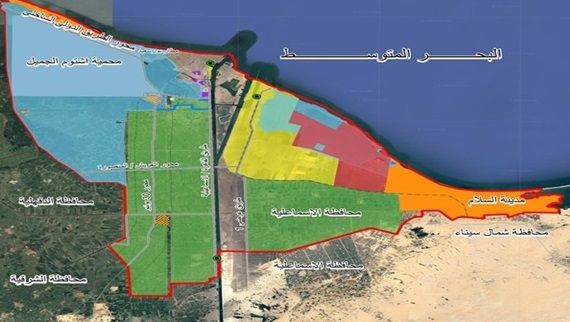
Title: Map shows the administrative boundary of the city.
Source: Port Said Governate.
Port Said Governorate is considered one of the major cities, with a population of approximately 789,241 people, representing about 0.8% of Egypt’s total population. The percentage of children under 15 years old is around 27.2%, while the age group of 15 to 29 years old is around 27.3% of the total population. The population density in the Governorate is 591 people/km2, and the average household size is estimated at 3.92 members per household.
The population is distributed across the neighborhoods of Port Said City, the most densely populated Al-Zohour neighborhood, with a population of 224,000 people, followed by Al-Dawa’hi, with a population of 145,000 people. Furthermore, Port Said has a diverse population in terms of nationalities and ethnicities, where the percentage of Arab Egyptians is 68%, the percentage of Upper Egyptians is 29%, and the remaining percentages are as follows: Arab Bedouins 1.6%, Sudanese nationality 0.6%, and other nationalities more than 0.8%.
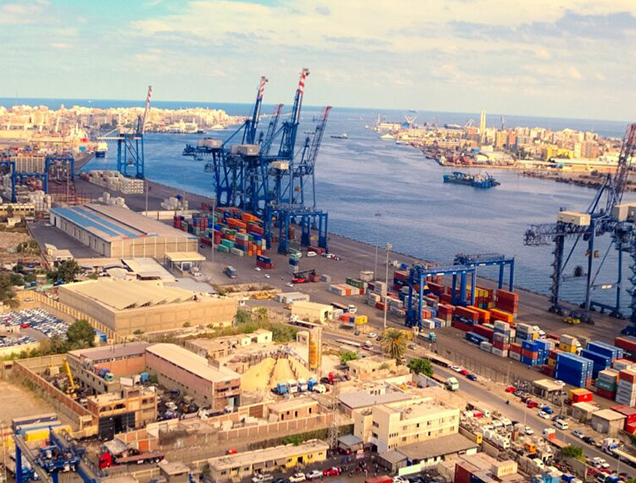
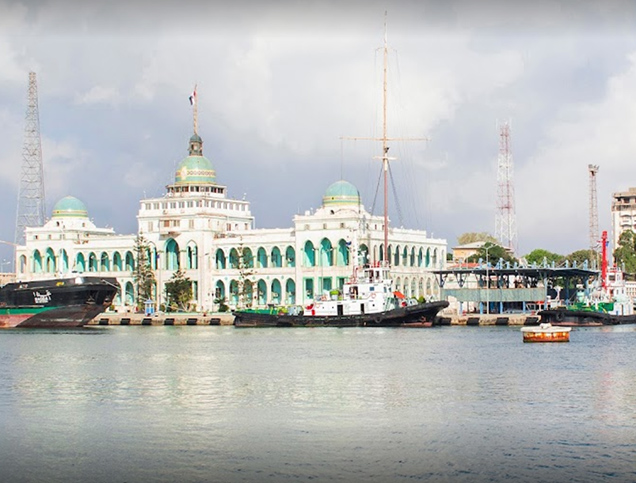
Title: West Port Said Port.
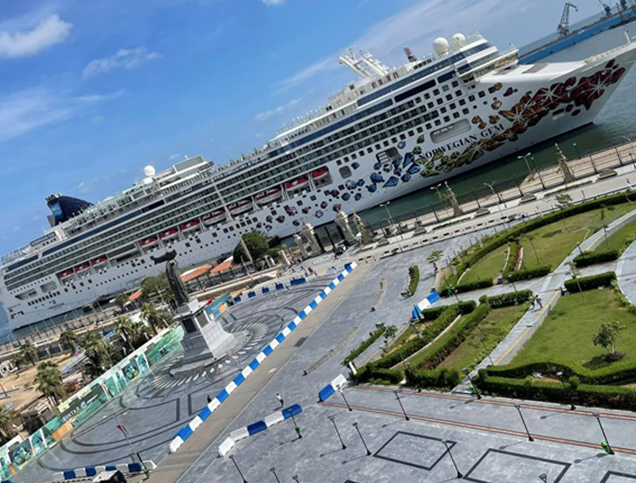
Title: Egypt Square.
Source: Port Said Governate.
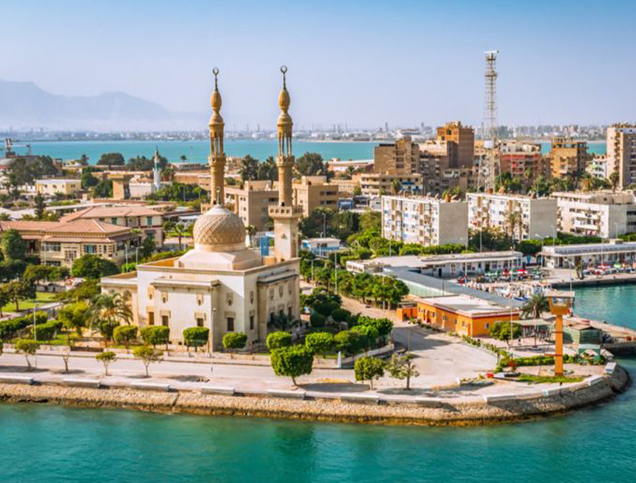
Title: View from Port Said City.
Source: https://rb.gy/0zsdst
Title: Bahr al-Baqar Wastewater Treatment Plant (The Largest in the World).
Source: https://e3rafportsaid.portsaid.gov.eg/olds/Details?Hotelid=133
Title: West Port Said Port.
Title: Egypt Square.
Source: Port Said Governate.
Title: View from Port Said City.
Source: https://rb.gy/0zsdst
Title: Bahr al-Baqar Wastewater Treatment Plant (The Largest in the World).
Source: https://e3rafportsaid.portsaid.gov.eg/olds/Details?Hotelid=133
Port Said is characterized by a flat topography, where the elevation ranges from half a meter to one meter above sea level, as it is part of the coastal sandy strip. The region is also characterized by the absence of any topographic features, such as slopes and terrain, whether elevations or depressions.
Port Said also enjoys a moderate climate throughout the year, where hot and dry weather prevails throughout the year. The rainfall is relatively low, with an average annual temperature of 21.4°C. The relative humidity values decrease as one moves further south, away from the coast and water bodies, such as Al Manzala Lake.
The Governorate has adopted the use of renewable and clean energy through the launch of solar-powered streetlights in several areas and streets. The waste management system in the Governorate is also being updated, through the development of waste infrastructure, the activation of sustainable waste systems, and the encouragement of recycling recyclable materials. A solid waste recycling plant has also been established west of Port Said, and organic waste is being converted into organic fertilizer that can be used in agriculture.
In the context of implementing international agreements to conserve migratory species of wild animals, protect resident and migratory seabirds, and safeguard fish stock from overfishing, Port Said is working to encourage sustainable fishing techniques and develop regulations and laws to organize fishing activities. It is also working to develop Al Manzala Lake, as it is a habitat for migratory birds, and to prevent the lake’s water from entering agricultural lands. In addition, the Governorate is carrying out continuous dredging and reopening of inlets and channels to allow for increased inflow of saltwater, which enables the presence of new species of aquatic organisms.
Aiming to address climate change and improve air quality, green areas and parks have been established, in addition to the development of the Ferial Garden and participation in the Presidential initiative “100 Million Trees.”
The economic activities in the Governorate are diverse, including industrial, logistics, agricultural, and tourism activities, as follows:
The Industrial Sector: The Governorate includes industrial zones in the east, south and west of Port Said, as well as the Economic Zone and the Public Free Zone, which include various industries such as wood, electrical, textile, packaging, and others. The number of factories in the industrial zone south of Port Said reaches about 466 factories. In addition, 54 factories were established as small projects for EGP 208 million in food, engineering, and chemical activities. Also, 58 factories were established at an investment cost of EGP 26 million, including ready-made garments, plastic, leather, and cardboard industries, in addition to small and micro projects implemented by the Small and Medium Enterprises Development Authority, which reached about 1979 projects with a financing volume of EGP 67.852 million, as well as 62 factories under the (3rd July Project for Youth).
There is also the West Port Said Port, which has a commercial port consisting of multiple facilities such as containers, ship services, and petroleum services, as well as a tourist port with three berths totaling 400 meters in length and a building equipped with reception halls. In addition, there is East Port Said Port, which is equipped with deep-water facilities capable of accommodating large ships and includes a value-added green logistics center in East Port Said.
The Agricultural Sector: The Governorate has achieved self-sufficiency in rice production at a rate of 100% and wheat production at a rate of 101%. It also contributes to the cultivation of sugar beet as a strategic crop for the sugar industry to support the reduction of Egyptian imports. In addition to development projects such as fish farming in the east and west of Port Said, there are food production projects for oils, fish products, bakery and others.
The Tourism Sector: Tourism is witnessing remarkable development, with an influx of visitors and an increase in revenues, as well as a diversity of tourism types, such as bird watching tourism, especially flamingos, one-day tourism to commercial places and Salt Mountain, in addition to tourism to archaeological sites.
In 2021, Port Said was declared the first Governorate free of informal settlements, in partnership with the Urban Development Fund through a grant from the European Union to eliminate unsafe areas and ensure that all citizens have access to suitable housing and services. A total of 44,100 housing units have been built since 2014 to meet the housing needs of citizens, including:
• 4,080 housing units in the cooperative housing project, which includes (3,080 cooperative housing units and 1,000 investment housing units), in cooperation with the General Authority For Construction & Housing Cooperatives.
• 2,530 housing units in the investment project.
• 29,148 housing units in “Housing Projects for All Egyptians” projects (Emirates 1, Emirates 2, Computer and Freedom, Third Stage, and Blue Brochure).
• 7,316 housing units are used as an alternative to informal settlements, and 1,026 housing units are used as an alternative to removals to eliminate the waiting lists for housing units and stabilize families in safe homes.
In 2017, the number of residential buildings in Port Said reached approximately 36.6 thousand buildings. Several major projects have also been established to develop housing services, such as:
• Establishing a desalination plant west of Port Said with a capacity of 20,000 m3/day.
• Establishing water transmission lines for EGP 400 million.
• Establishing a dual treatment plant and sanitation (C9) serving (Kabouti, Al-Dawa’hi, Al-Zahour, Al-Diba and Borfouad Social Housing) for EGP 200 million.
• Establishing the largest wastewater desalination plant in the world (Bahr al-Baqar) to irrigate nearly half a million acres in eastern Port Said.
Port Said is characterized by the diversity of its basic transportation facilities, including El Gamil Airport, the Port Said Railway Station, and the ports west and east of Port Said. Transportation methods also vary, including private and taxi cars, public buses, and ferries to travel to and from Port Fouad City. Additionally, a large sector of the population prefers to use motorcycles. The Governorate also includes several bridges, the most prominent of which is the Floating Victory Bridge, which serves as a link between the cities of Port Said and Port Fouad to facilitate daily movement between the two cities without obstructing the navigation of ships in the Suez Canal waterway. These bridges also contribute to reducing the congestion of transport vehicles in the East Port Said projects, reducing crossing time, and improving the service of transporting goods from east to west and vice versa for the benefit of the Egyptian national economy. They also eliminate the periods of stoppage and waiting in front of the canal banks for all types of vehicles and pedestrians and stimulate trade exchange between the West Port and the East Port in Port Said and other ports.
The Governorate also adopts the continuous goal of developing, upgrading the efficiency of, and periodically expanding the roads within the integrated and sustainable human settlement planning and management framework to facilitate movement and mobility. The efficiency and maintenance of a number of roads in all districts, totaling 1,034 km, were improved by 2020. The construction works started in 2021 and were carried out on roads with a total length of 100.77 km; hence, the efficiency of 119 km of roads was improved.
Moreover, Port Said Land Port was established as part of the development of the Governorate’s entrance from the 30th of June axis. It includes a complex of parking lots for land transport companies between the governorates (Superjet, West and East Delta, and Go Bus) and parking for various travel vehicles (taxis and service vehicles) to facilitate travelers to and from the Governorate.
References:
1. Port Said Voluntary Local Review 2023 – Ministry of Planning and Economic Development (UNDP).
2. Official Website for the Ministry of Environment.
3. Port Said Governorate.
4. Citizen Investment Plan Report (2022/2023)- Ministry of Planning and Economic Development.
5. https://tinyurl.com/yx72mx7z
An online library where you can explore relevant data on urban development in the Arab cities.
More


Lorem ipsum dolor sit amet consectetur. Lacus nibh neque erat massa elementum. Ultricies ante sed sed nunc massa ider.
Last updated 3 mins ago
Lorem ipsum dolor sit amet consectetur. Lacus nibh neque erat massa elementum. Ultricies ante sed sed nunc massa ider.
Last updated 3 mins ago
Lorem ipsum dolor sit amet consectetur. Lacus nibh neque erat massa elementum. Ultricies ante sed sed nunc massa ider.
Last updated 3 mins ago
Lorem ipsum dolor sit amet consectetur. Lacus nibh neque erat massa elementum. Ultricies ante sed sed nunc massa ider.
Last updated 3 mins ago
Lorem ipsum dolor sit amet consectetur. Lacus nibh neque erat massa elementum. Ultricies ante sed sed nunc massa ider.
Last updated 3 mins ago
Lorem ipsum dolor sit amet consectetur. Lacus nibh neque erat massa elementum. Ultricies ante sed sed nunc massa ider.
Last updated 3 mins ago





